.png.webp)
How is Jewelry Made? A 6-Step OEM Manufacturing Guide for Brands
Discover the jewelry manufacturing process: the critical engineering and rigorous steps required to transform a design sketch into high-quality, mass-produced jewelry.
Understanding exactly how fine jewelry is made is the first step for any brand looking to scale. Whether you are curious about how custom jewelry is made for a boutique collection or the large-scale manufacturing of jewelry for wholesale, the underlying principles of engineering, precision, and quality control remain the same. Let’s dive into the core steps.
From Concept to CAD: Engineering the Master Blueprint
In commercial jewelry manufacturing, a beautiful sketch is only the beginning. The transition from a 2D concept to a physical product requires exact industrial engineering to ensure structural integrity.
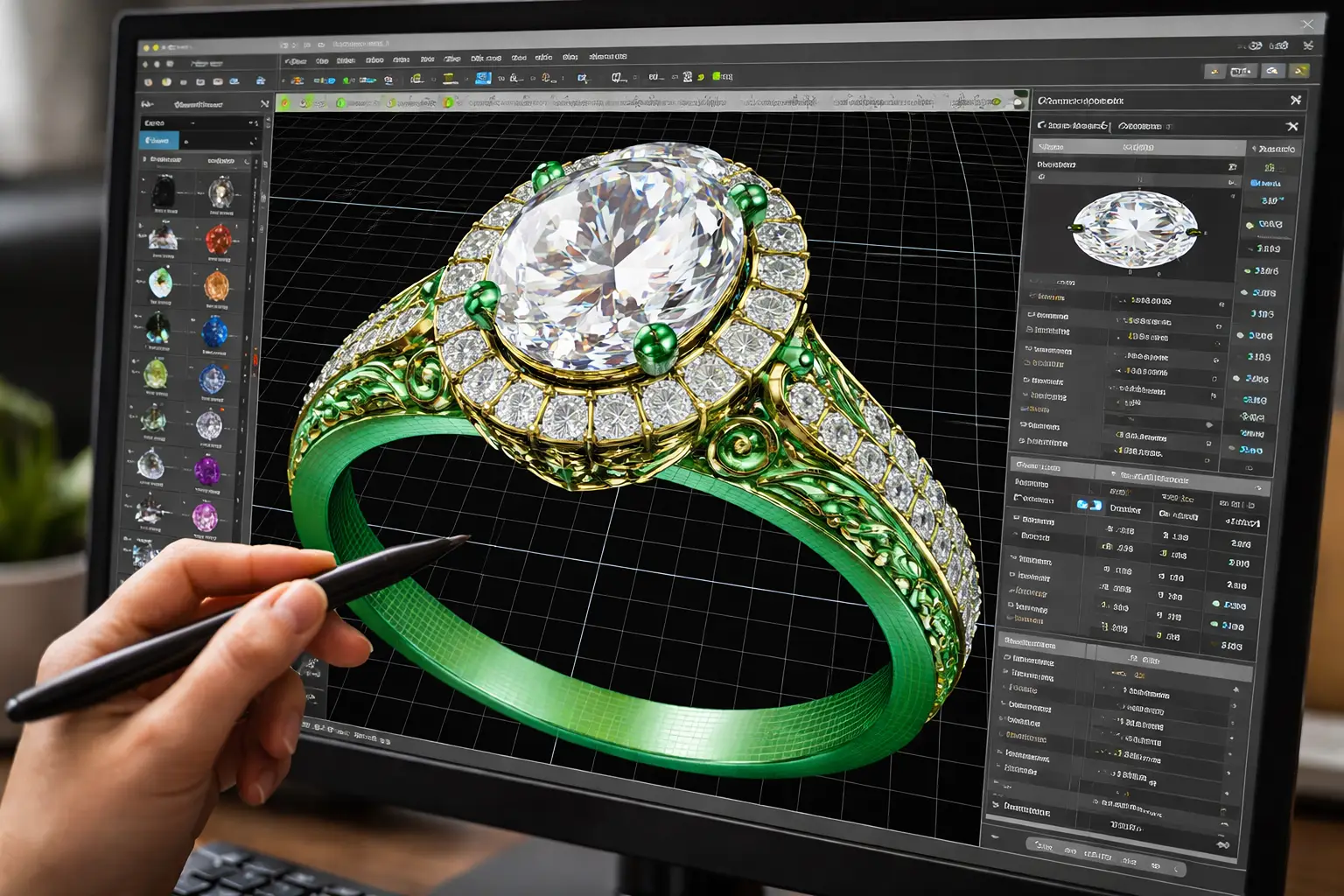
Translating Sketches into 3D CAD Models
Using advanced software like MatrixGold or Rhino, engineers translate artistic concepts into precise 3D data. High-resolution 3D renderings are generated at this stage, allowing brands to approve the final look before any physical material is utilized. For budgeting purposes, creating the initial CAD file and the first 3D printed prototype typically costs between $100 to $300 USD, depending on the design’s structural complexity.
The Critical Math of Metal Shrinkage and Stone Tolerances
Prototyping and Rubber Mold Making: The Foundation of Scaling
Once the CAD file is perfected, it must be brought into the physical world. For OEM brands looking to produce 50 to 5,000 units, establishing a flawless master mold is the ultimate cost-control strategy.
3D Printing the Master Wax Pattern
The CAD file is sent to an SLA or DLP 3D resin printer to create the master pattern. To minimize gold loss during the final polishing phase, high-end jewelry printers operate at a microscopic layer thickness of 25 to 50 microns.
Vulcanizing Rubber Molds for OEM Production
For mass production, a master silver model is cast. This metal master is packed in uncured rubber and placed in a vulcanizer at 150∞C to 165∞C under high pressure. A master mold-cutter then uses a surgical scalpel to cut the rubber mold, preparing it for the replication phase.
The Lost-Wax Casting Process: Transforming Wax into Precious Metal
If you’ve ever wondered how is gold made into jewelry, this phase is the heartbeat of the operation. The lost-wax casting process is a highly volatile physical transformation where poor temperature control can lead to porosity (microscopic holes).
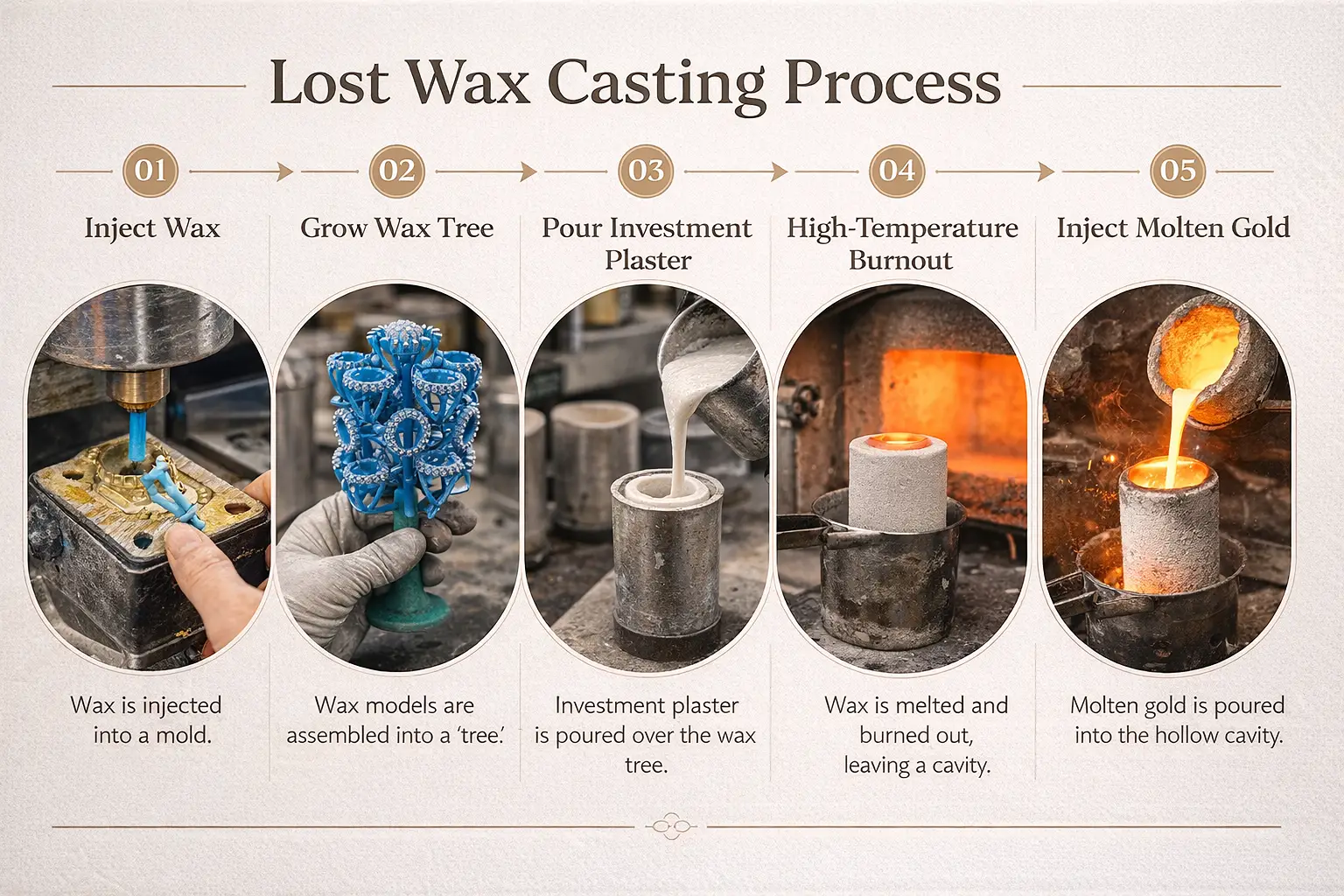
Wax Injection
Before casting, we must mass-produce the wax models. Pressurized liquid wax is injected into the master rubber mold. Once cooled, the mold is opened to reveal a perfect wax replica of the jewelry. This step allows a factory to produce hundreds of identical pieces for a single batch.
Treeing, Spruing, and Investment Preparation
Dozens of identical wax patterns are soldered onto a central wax sprue at specific 45-degree angles, creating a “wax tree.” This tree is placed inside a steel flask and filled with liquid investment (plaster). Crucially, the flask must undergo a strict vacuuming process to eliminate trapped air bubbles.
Burnout, Melting, and Vacuum Casting Mechanics
How gold jewelry is made relies heavily on thermal control. The flask is placed in a burnout kiln and subjected to a stepped heating cycle (exceeding 700∞C) to completely vaporize the wax. However, the flask must be carefully cooled down to 500∞C – 600∞C before molten gold (at around 1000∞C) is forcefully injected using vacuum casting machines. Injecting gold into an overheated flask causes severe gas porosity and brittle metal.
Commercial Quality Control: Beating the Porosity Trap
For established brands, controlling porosity is directly tied to profit margins. Gas trapped during casting causes microscopic surface pitting, leading to high return rates. This is why top-tier manufacturers like Azone Jewelry partner exclusively with advanced casting facilities, utilizing strict vacuum controls to maintain a defect rate of less than 3%.
Pre-Finishing and Structural Assembly
When the metal tree cools, the plaster is dissolved, and the rough “blanks” emerge. Artisans clip the individual pieces from the central sprue and begin the initial filing process to remove casting lines. For brands that ask how is enamel jewelry made or require custom epoxy color fills, the recessed areas are prepared at this stage.
Modern high-end manufacturing heavily relies on Laser Welding rather than traditional fire soldering. Laser welding provides microscopic heat control, preventing discoloration and protecting delicate areas of the jewelry.
Precision Stone Setting: Securing the Value of the Piece
Stone setting requires immense manual dexterity to secure gemstones without applying excessive pressure that could cause fractures.
Prong vs. Bezel Setting: Security and Aesthetics
| Setting Type | Mechanism & Process | Security Level | Best for OEM Scenarios |
|---|---|---|---|
| Prong Setting | Metal claws are bent over the stone. Artisans use a cup bur to round the tips. | Moderate to High | High-Margin Statement Pieces. Maximizes brilliance, perfect for engagement rings or premium boutique lines. |
| Bezel Setting | A metal rim is hammered precisely to overlap the stone’s girdle continuously. | Maximum | Mass-Market & Daily Wear. Ideal for high-volume fashion jewelry with a near-zero stone-loss rate. |
Micro-PavÈ Setting under High Magnification
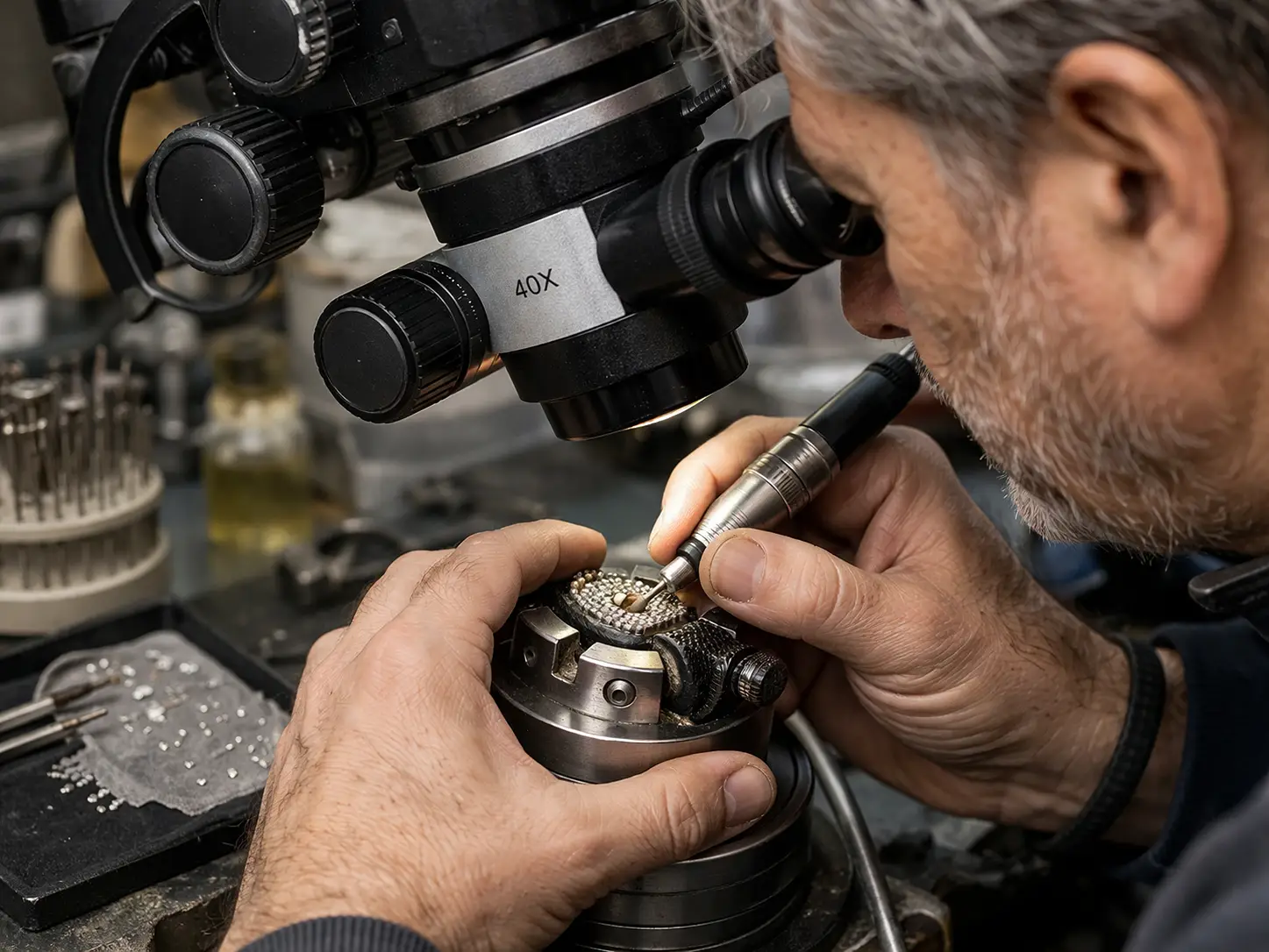
For luxury items, artisans utilize the Micro-PavÈ technique. Working entirely under 40x microscopes, setters use pneumatic engravers to cut tiny beads of metal directly from the band to hold the stones, creating a seamless surface of light.
Surface Treatment and Plating
The final visual phase involves aggressive buffing using cotton wheels to achieve a mirror finish. The jewelry is then subjected to ultrasonic cleaning to remove all residual oils.
Many clients ask how is gold plated jewelry made to ensure longevity. The secret lies in the electrolytic bath preparation. At Azone, pieces undergo strict electro-cleaning before receiving precise plating thicknesses ranging from 0.5 to 2.5+ microns of 18K gold, Rose Gold, or Rhodium, ensuring a brilliant finish that won’t easily tarnish.
Final Gateway: Strict Quality Control & Testing
Before any piece is shipped, it must pass through a strict Quality Control (QC) gateway. Buyers often wonder how to tell what metal jewelry is made of and if it meets safety standards. Professional OEM factories utilize XRF (X-ray fluorescence) scanners to guarantee metal purity and ensure products are 100% lead and nickel-free.
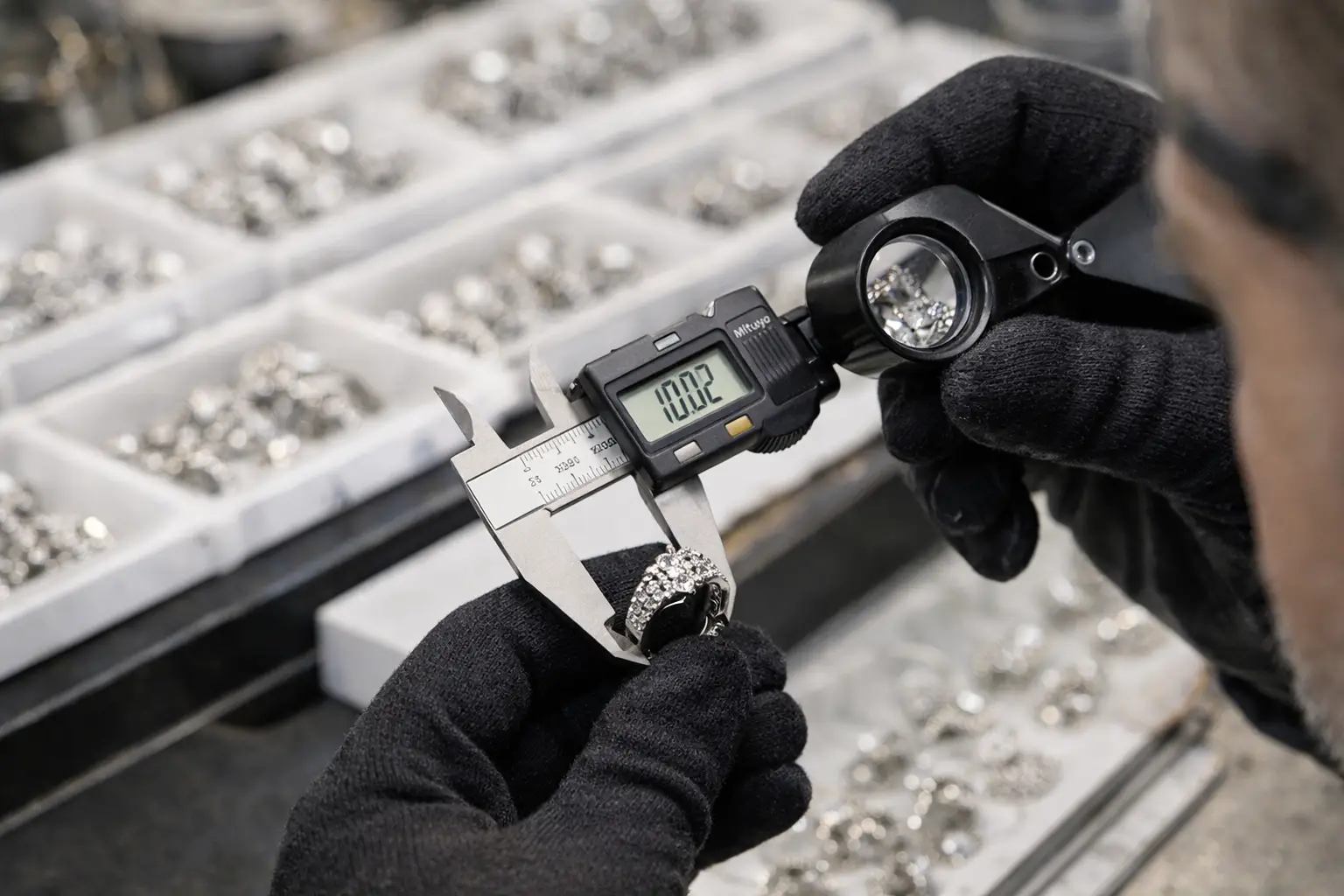
Beyond visual inspections, our QC engineers conduct the “tweezer test” to check for loose stones, perform pull testing on chains to guarantee weld strength, and strictly check dimensional tolerances against the original CAD file.
Build Your Collection with a Certified Manufacturing Partner
For brands targeting the European and North American markets, beautiful craftsmanship is only the baseline. At Azone Jewelry, we protect your business on all fronts:
- Absolute IP Protection: We sign strict Non-Disclosure Agreements (NDAs). Your designs and custom molds belong 100% to you.
- Unmatched Warranty: We offer a 1-to-2-year plating warranty backed by salt spray and artificial sweat testing.
- Global Compliance: Fully compliant with EU REACH, BSCI standards, and offering GRS-certified recycled materials.
Flexible MOQ (50-100 pcs) ” <3% Defect Rate ” Zero IP Theft Guarantee


 English
  Spanish
  French
  German