.png.webp)
Lost Wax Jewelry Casting: Process, Quality Benchmarks, and How to Choose a Manufacturing Partner
What Is Lost Wax Jewelry Casting?
Lost wax casting — known in French as cire perdue, literally “lost wax” — is one of the oldest metal-forming techniques still in active use, with archaeological evidence tracing back over 6,000 years to ancient Egypt and Mesopotamia. The principle is elegantly simple: a wax model of the desired piece is encased in a heat-resistant mold, the wax is melted and burned away, and molten metal fills the cavity left behind. What emerges is an exact metal replica of the original wax form, capable of reproducing details as fine as 0.2 millimeters.
In jewelry manufacturing, lost wax casting remains the gold standard for a reason no other method has matched: it can produce complex three-dimensional geometries — organic curves, undercuts, hollow sections, filigree — that stamping, die-striking, or CNC machining simply cannot achieve in a single piece. While modern technologies have transformed how the wax model is created (more on that later), the core casting principle has remained fundamentally unchanged for millennia. Understanding this process is the first step to making informed decisions about your jewelry production — whether you’re designing your first collection or evaluating a new manufacturing partner.
The Lost Wax Casting Process: From Wax Model to Finished Piece
Each stage of lost wax casting builds irreversibly on the last. A flaw in the wax model replicates faithfully into the plaster mold; a crack in the mold amplifies during the metal pour; a rushed finishing job can ruin an otherwise perfect casting. Understanding this causal chain is more important than memorizing temperature numbers — it tells you where quality is won or lost.
Creating the Wax Model — Carving, Building, and Printing
The wax model is not a rough sketch. It is the exact negative of your final piece — every surface texture, every dimensional relationship, every detail present in the wax will appear in the metal. There are three primary ways to produce it.
Hand carving uses specialized jewelers’ waxes: hard carving wax (typically blue or green, melting around 90°C) is filed, sawn, and burred into geometric forms like ring bands and angular pendants; soft sculpting wax (pink) is malleable like clay, ideal for organic shapes, petals, and textured surfaces. Wax sheets and wire can be heated over an alcohol lamp and shaped by hand. This method excels for one-off artisanal pieces where the maker’s hand is part of the value — but it depends entirely on individual skill and is difficult to replicate with batch-to-batch consistency.
Rubber mold replication is the workhorse of production casting. A master model (which can be hand-carved or 3D-printed) is pressed between layers of uncured rubber under heat and pressure. Once vulcanized, the rubber is cut open and the master removed, leaving a cavity that can be injected with molten wax repeatedly — producing dozens or hundreds of identical wax copies. This is the standard approach for small-to-medium production runs where design consistency matters.
3D-printed wax patterns represent the modern front end of the lost wax workflow. Designs are modeled in CAD software like Rhino or MatrixGold, then printed in castable resin or wax filament using DLP or SLA printers with layer thicknesses as fine as 0.025 mm. The printed patterns then follow the identical investment → burnout → casting sequence as hand-carved wax. This approach eliminates hand-skill variance, enables geometries impossible to carve by hand (interlocking parts, perfectly symmetrical latticework), and allows the same digital file to produce identical castings across different production batches — a critical advantage for brands that need consistency across seasons.
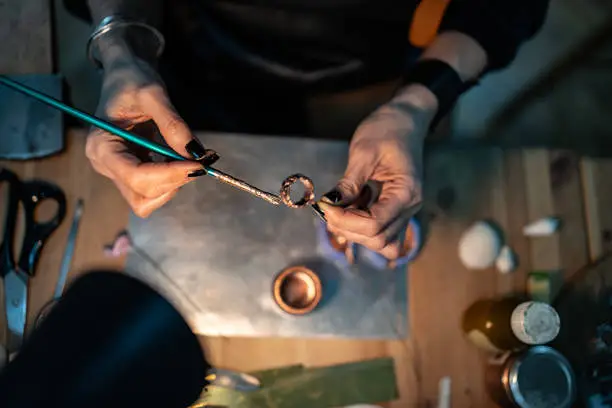
Whichever method you use, the wax model’s weight determines how much metal you’ll need. The formula: wax weight × metal specific gravity = required metal mass. For silver, multiply by approximately 11; for 14K gold, by approximately 14; for brass, by approximately 9.
Investment and Burnout — Building the Mold
Investment — the process of encasing the wax model in a refractory plaster mold — is the stage most invisible to the end customer, yet it’s where the majority of casting failures originate.
First, the wax model is “sprued”: a wax rod is attached to the thickest section, creating the channel through which wax will later escape and molten metal will enter. For multi-piece production, multiple wax models are mounted onto a central wax stem, forming a “tree.” Sprue placement is an engineering decision — too thin, and metal won’t flow; poorly positioned, and turbulence creates porosity.
The wax tree is placed inside a steel flask, and investment powder — a carefully formulated blend of gypsum and silica — is mixed with water at a precise ratio of 38–40 parts water to 100 parts powder by weight. This slurry is vacuum-degassed to remove air bubbles (any bubble against the wax surface becomes a bump on the final casting), poured into the flask, and left to cure for 2 to 4 hours.
Then comes burnout — the critical thermal cycle. The flask goes into a programmable kiln for a staged ramp:
| Phase | Temperature | Duration | Purpose |
|---|---|---|---|
| Wax elimination | 150–200°C | ~1 hour | Melt wax out gently without cracking the mold |
| Residual burnout | ~400°C | ~1.5 hours | Burn off any remaining wax residue |
| High-temperature soak | 720°C (silver) / 850°C (gold) | 1–2 hours | Harden the investment and preheat for casting |
Ramp too fast, and thermal shock cracks the mold — producing castings with flash lines. Undershoot the high soak, and residual wax ash blocks metal flow — causing incomplete fills. The flask must go from kiln to casting station within 60 seconds; beyond that, mold temperature drops below the metal’s flow threshold.
Pouring the Metal — Centrifugal vs. Vacuum Casting
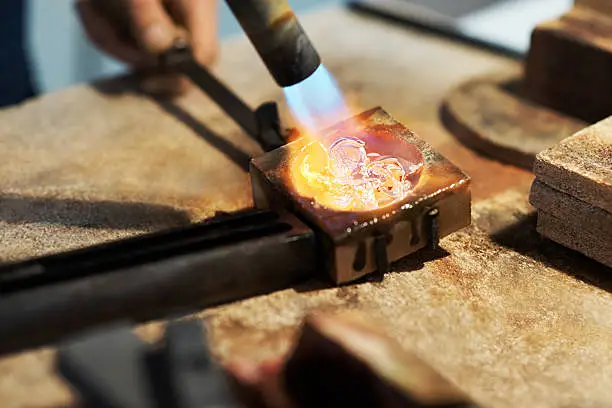
Once the flask is out of the kiln, the pour window is measured in seconds. Two methods dominate jewelry casting:
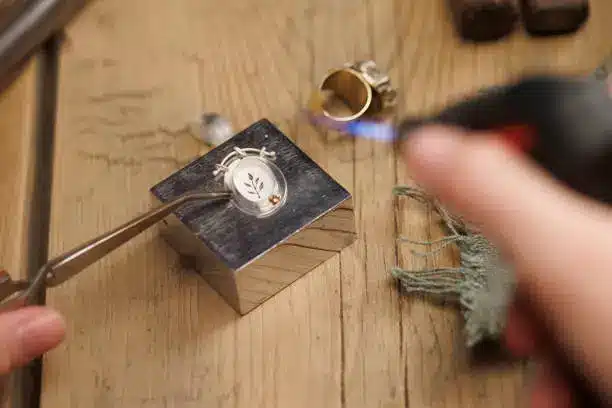
Centrifugal casting uses a spring-driven arm. Metal is melted in a crucible with an oxyacetylene torch; when the operator releases the arm, centrifugal force (typically 300–500 rpm) drives molten metal into the mold cavity. The high G-force fills thin sections aggressively — ideal for long, slender pieces like chain links and delicate prongs. The trade-off: turbulent flow can trap gas bubbles, creating micro-porosity.
Vacuum casting places the hot flask on a vacuum table. Metal is melted and poured into the sprue opening; the vacuum pump (pulling approximately −0.08 to −0.1 MPa) draws the metal down through the cavity from below. The result is typically less porous and yields a cleaner surface finish. The limitation: vacuum force alone may struggle to fill extremely thin-walled sections that centrifugal force would push through.
The casting temperatures matter enormously: sterling silver pours at 960–980°C, 14K gold at 900–950°C, brass at 1,000–1,050°C. Stainless steel (316L) requires temperatures above 1,100°C and specialized high-temperature investment — not every casting house has this capability.
Divesting, Cleaning, and Finishing
If you think the casting coming out of the mold is a finished piece, you’re seeing only half the picture. Post-processing typically accounts for 40–50% of total production labor.
The red-hot flask is quenched in cold water — the thermal shock shatters the plaster investment while simultaneously annealing the metal, softening it for the work ahead. Individual pieces are cut from the tree with a jeweler’s saw, and sprue stubs are ground away. The castings go into a pickle solution (typically 10–15% sulfuric acid or saturated citric acid, heated to 60–70°C) to remove fire scale and surface oxides.
Then comes the finishing cascade: coarse filing to remove sprue remnants and parting lines → progressive sanding (180 grit → 400 grit → 800 grit) → buffing with polishing compound on a cotton wheel → ultrasonic cleaning. A casting fresh from the mold has a surface roughness around Ra 3.2–6.3 μm — visibly matte. After full polishing, that drops to Ra 0.05–0.1 μm — a mirror finish. The difference between a mediocre casting and an excellent one is often determined not in the pour, but in the hands doing the finishing.
Metals and Materials Compatible with Lost Wax Casting
Not every metal casts equally well. The table below maps the most common jewelry metals to their casting characteristics:
| Metal | Casting Difficulty | Pour Temperature | Best For | Surface Finish Options | Key Consideration |
|---|---|---|---|---|---|
| 925 Sterling Silver | Moderate | 960–980°C | Fine jewelry, mid-premium pieces | Polishing, brushing, rhodium plating, oxidation | 7.5% copper content adds hardness; prone to fire scale without protective atmosphere |
| 10K–18K Gold | Moderate-High | 900–950°C | Premium collections, engagement rings | High-polish, matte, sandblast | ~1.25–1.5% casting shrinkage; CAD models must pre-compensate |
| Brass (Copper-Zinc) | Moderate | 1,000–1,050°C | Vintage/retro styles, fashion jewelry | Gold/silver/rose gold plating, antique finishing | Zinc evaporation at pour temperature causes porosity; tight temperature control required |
| Stainless Steel 316L | High | 1,100°C+ | Hypoallergenic daily-wear pieces, men’s jewelry | PVD plating (gold/rose gold/black), brushing, mirror polish | Requires specialized high-temp investment and furnace; not all casting houses handle it |
| Bronze | Moderate | 950–1,050°C | Artisanal, sculptural pieces | Patina, polishing, wax seal | Tin content variation changes color and casting behavior significantly |
| Platinum | Very High | 1,770°C+ | Luxury bridal, heirloom pieces | High-polish, matte, sandblast | Extremely high pour temperature; requires dedicated equipment; only ~29% of casting houses have capability |
Choosing the right metal comes down to three variables: who wears it (hypoallergenic requirement → stainless steel or nickel-free gold), what it costs (budget-conscious → brass with quality plating; premium → gold or platinum), and what look it needs (warm vintage → brass; cool contemporary → stainless steel; timeless value → silver or gold).
3D Printing and Modern Lost Wax Casting
3D printing hasn’t replaced lost wax casting — it has transformed its front end. The bottleneck in traditional casting has always been wax model creation: hand carving is slow and skill-dependent, and rubber molding requires a master to exist first. CAD-to-cast workflows break both constraints.
A designer now creates the piece digitally in Rhino, MatrixGold, or similar jewelry CAD software, outputs a castable resin or wax pattern from a DLP or SLA 3D printer, and feeds that print directly into the standard investment-and-casting pipeline. The casting process itself — burnout, pour, finishing — remains identical to what a hand-carved wax model goes through.
This matters for brands in three specific ways. First, consistency: a digital file produces identical wax patterns every time, eliminating the batch-to-batch variation inherent to hand work. Second, complexity ceiling: geometries like perfectly symmetrical latticework, interlocking chain links, and mathematically precise pavé stone settings become feasible — these are geometries a hand carver would take days to produce, if at all. Third, iteration speed: a design can be adjusted in CAD and reprinted overnight, versus re-carving from scratch.
The print quality requirements are unforgiving. Castable resins must have ash content below 0.1% — any higher, and burnout residue leaves micro-porosity throughout the casting. The CAD model must pre-compensate for metal shrinkage (typically 1.5–2.5%, depending on the alloy) by scaling up the digital model. And layer lines — the telltale ridges of 3D printing — must be post-processed off the print or printed fine enough (≤0.025 mm layer height) to disappear during casting.
3D printing makes lost wax casting more precise. It doesn’t make it simpler. The burnout cycle, the pour, the finishing — those haven’t changed. The skill just shifted upstream, from the carving bench to the CAD workstation.
Quality Benchmarks — What Separates Good Casting from Bad
Most writing about lost wax casting skips the hard part. The process itself is agnostic. The same six steps can produce a flawless heirloom or a porous piece that snaps at the first wear. Quality is determined not by which process you use, but by the standards enforced at each stage. Think of it as a three-cornered framework: surface integrity (what you can see), coating durability (what time reveals), and batch consistency (what the data says). A failure in any corner means the entire batch is compromised.
Surface Finish, Porosity, and Dimensional Accuracy
When you receive a casting sample, check these specific things — and hold the factory to these benchmarks.
Surface finish: A properly cast piece, fresh from the mold, has a surface roughness of Ra 3.2–6.3 μm — visibly matte but free of sand holes, cold shuts (wrinkles where metal flow stalled), or pitting. After full polishing, the target is Ra ≤0.1 μm — a true mirror finish. Take a 10× loupe and scan high-stress zones: ring shanks, pendant bail attachments, earring posts. These areas concentrate force and cannot tolerate porosity.
Porosity: Some micro-porosity is inherent to the casting process — the question is where and how much. Gas porosity appears as spherical voids, typically caused by turbulent metal flow or inadequate degassing. Shrinkage porosity appears as irregular, angular cavities, usually where thick sections meet thin ones (the sprue attachment point is a common trouble spot). The industry standard: pores under 0.2 mm in non-load-bearing surfaces are acceptable; ANY visible porosity in a structural connection point (clasp, bail, post, shank) is a reject.
Dimensional accuracy: Measure critical dimensions with a digital caliper. Ring inner diameters, pendant lengths, earring post gauges — these should be within ±0.1 mm of the specification drawing. Precision casting houses can hold ±0.05 mm. If your 18 mm ring shank arrives at 17.7 mm, that’s not “close enough” — it’s a pattern of undersizing that will repeat across the batch unless the CAD compensation factor is corrected.
Plating and Coating Durability — The Test of Time
Plating failure is the number one driver of jewelry returns. A piece that looks perfect on arrival but shows brass showing through gold plate after three months of wear destroys brand trust faster than any other quality issue.
The durability gap between plating methods is measured in orders of magnitude. Standard electroplating deposits a layer 0.1–0.5 μm thick with a hardness of 100–150 HV (Vickers). PVD (Physical Vapor Deposition) plating deposits 1–3 μm at 2,000–3,000 HV — roughly five to ten times the wear resistance. The cost difference is real (PVD runs roughly two to three times electroplating per piece), but so is the return-rate difference.
Before placing an order, ask the factory which of these tests they run in-house. Salt spray testing (ASTM B117 standard — 5% NaCl fog at 35°C for 24–72 hours) evaluates corrosion resistance. Artificial sweat testing (ISO 3160 — simulates prolonged skin contact over 48–72 hours) predicts real-world tarnish behavior. Tape adhesion testing (3M tape pressed and peeled — any plating that lifts is inadequately bonded). Abrasion testing (standardized friction head, count cycles to substrate exposure) gives a wear-life estimate.
The industry norm is a 1–2 year plating warranty. But there’s an important distinction: a factory that says “we guarantee our plating” and one that writes the warranty terms — including exactly what’s covered, for how long, and what remedy applies — into the production contract are not the same thing. Look for manufacturers who back their plating with a written warranty and can produce test reports for each production batch.
Defect Rates and What “Good Enough” Really Means
Zero defects does not exist in production manufacturing. The factories that claim it are either not inspecting, or not being honest. What separates professional casting operations is not the absence of defects — it’s the transparency about defect rates and the accountability when they occur.
The jewelry casting industry’s accepted comprehensive defect rate sits at 3–5%. Factories operating below 3% are performing at the top of the field. Defects fall into three tiers: Class A (functional — breakage, severe deformation, loose stones) must be zero-tolerance; Class B (cosmetic — minor surface pits, slight color variation, micro plating inconsistencies) should be held to 2–3%; Class C (microscopic — detectable only under 10× magnification) is a brand-level decision based on your market positioning.
The single most reliable quality signal a factory can send is this: they state their defect rate in the contract, and they specify what happens when it’s exceeded. That’s it. Not “we care about quality.” Not “our workers are skilled.” A contract that says “< 3% comprehensive defect rate, with rework or replacement on any batch exceeding that threshold” is worth more than a hundred quality assurance platitudes.
How to Choose a Lost Wax Casting Partner
You now understand the process. You know what quality looks like. The remaining question is: how do you find a factory that actually delivers it?
The goal is not to find the “best” casting partner in some absolute sense. It’s to find the partner whose capabilities match your product type, quality requirements, and growth stage. A factory producing 500,000 pieces a month may be the wrong choice for a brand launching with a 50-piece trial order — their processes are optimized for volume, not flexibility. A boutique workshop specializing in gold fine jewelry may be equally wrong for your stainless steel streetwear line. Match before you evaluate.
Certifications, Compliance, and What They Actually Mean
Certifications are the closest thing to hard evidence you’ll get before placing a sample order. But not all certifications measure the same thing — and a wall of logos without expiration dates is a red flag, not a credential.
| Certification | What It Actually Certifies | Why It Matters | Key Detail to Verify |
|---|---|---|---|
| REACH | EU chemical compliance — Annex XVII limits nickel release to ≤0.5 μg/cm²/week | Mandatory for selling into the European market; non-compliance = customs rejection | Request the test report for your specific alloy, not a generic factory certificate |
| GRS (Global Recycled Standard) | Recycled material content ≥20%, full supply chain traceability, environmental + social management | Required by sustainable/ethical brands; increasingly demanded by European retailers | Verify certification tier (GRS 4.0 is current); check scope covers jewelry, not just textiles |
| BSCI | Social compliance audit — factory labor standards (wages, hours, safety, child labor) | European brands frequently mandate BSCI for supplier onboarding | Audit grade A–E; C or above is passing; request the corrective action plan if grade C |
| SGS / Third-Party Testing | Product-level lab testing (lead, cadmium, nickel release, plating thickness) | Independent verification — different from factory self-declaration | Request the full test report PDF, not just the cover page; verify testing standard referenced |
| SMETA (Sedex) | Ethical trade audit — labor, health & safety, environment, business ethics | Required by many UK/European retailers and brands | Sedex member registration can be verified independently via the Sedex platform |
A certification is only as good as its currency. Most require annual re-audit. Ask for the certificate copy AND the most recent audit report. A factory unwilling to share audit reports is a factory you should not give your designs to.
Evaluating Production Capability — Beyond the Sales Pitch
Sales conversations with factories follow a predictable script. Every factory “specializes in quality,” “has experienced workers,” and “can handle your order.” Specific questions separate capability from claims. Here are the ones that work.
Sampling turnaround: “From receiving my design file to shipping a physical sample, how many days?” The industry benchmark is 7 days for flat-cut pieces (laser-cut or stamped components) and 14 days for cast pieces requiring mold-making. If the answer is “it depends” without a range, the factory doesn’t have a standardized sampling process — which means your production timeline will be equally unpredictable.
MOQ flexibility: “What’s the minimum order quantity, and how does per-unit pricing change at 50, 100, and 500 pieces?” A factory that accepts 50–100 pieces for a trial order but has structured pricing tiers that reward scaling is ideal for growing brands. A factory demanding 500+ minimum on the first order is signaling they don’t want small-brand business.
Production capacity: “What’s your monthly output in pieces, and what’s your typical lead time from order confirmation to shipment?” A factory occupying 1,500–3,000 square meters should deliver 300,000–800,000 pieces per month. Lead times of 15–30 days after design lock are standard. If the factory can’t articulate capacity in concrete numbers, they’re either too small to handle your scaling or too disorganized to track output.
In-house vs. outsourced: “Which processes happen in your own facility, and which do you subcontract?” An ideal casting partner handles wax injection, casting, plating, stone setting, and polishing under one roof. Each subcontracted process is a quality control handoff where things go wrong. In-house plating, in particular, correlates strongly with faster turnaround and more consistent finish quality.
Design feedback: “When you receive a new design file, do you provide manufacturability feedback before sampling, or do you just produce what I sent?” The best casting partners function as an extension of your design team — they flag wall thickness issues, undercut problems, and sprue placement concerns before cutting metal, not after. A factory that never pushes back on a design is either not looking carefully or doesn’t care about downstream problems.
Communication, IP Protection, and After-Sales — The Partnership Test
The quality of your casting partner reveals itself most clearly not during the easy first order, but during the difficult moments: a design revision, a quality dispute, a rush reorder.
Communication cadence: First inquiry response within 24 hours is the minimum. More telling is whether the person you initially speak with remains your point of contact throughout sampling and production — constant handoffs between representatives signal high internal turnover, which correlates with institutional knowledge loss and specification drift.
Design security: Before sending any design file, require a signed NDA (Non-Disclosure Agreement) that explicitly covers design drawings, 3D CAD files, mold ownership, and customer lists. Crucially, the production contract must state that molds — once the tooling fee is paid — belong to you, the client. A factory that retains mold ownership can produce your designs for other clients. This is not theoretical; it’s one of the most common IP disputes in jewelry manufacturing.
After-sales accountability: Ask directly: “If a batch arrives with defects exceeding the agreed rate, what exactly happens?” The answer should include specific remedies (rework at factory cost, replacement production, or credit toward future orders), a defined response window (7×24 hour technical support availability is a meaningful signal), and a named person responsible for resolution. A vague “we’ll take care of it” is not a process — it’s a hope.
¹If you’re building a supplier evaluation checklist, here’s a practical benchmark: a casting partner serving brand clients should be able to show you GRS, REACH, and BSCI certifications with current audit dates; deliver cast samples within two weeks; accept trial orders as low as 50 pieces; maintain a comprehensive defect rate below 3% with a contractual commitment to rework or replace; and back their plating with a written one-to-two-year warranty. Visit azonejewelry.com/about-us/ to see what two decades of specialized jewelry casting expertise looks like in practice — including 12 in-house production workshops, a 40,000+ design portfolio, and third-party-verified certifications.
²The difference between “we guarantee our plating” and “our PVD plating is backed by a two-year written warranty with documented salt-spray and artificial-sweat test reports per batch” is the difference between marketing and manufacturing. Before committing to a production run, ask to see a recent batch’s plating test data — not a sample, not a promise, the actual QA documentation. Some manufacturers, like Azone, maintain this as standard operating procedure across every production lot.
³If you have a jewelry design ready and want to understand its casting feasibility before approaching factories, having an experienced engineering team review your CAD file for manufacturability can save weeks of back-and-forth sampling. Request a DFM review here.
References
- MJSA. “Casting & Moldmaking Guides.” mjsa.org
- ASTM International. “ASTM B117.” astm.org
- ECHA. “REACH Regulation Annex XVII.” echa.europa.eu
- Textile Exchange. “GRS 4.0.” textileexchange.org
- Amfori. “BSCI Audit System.” amfori.org
- Sedex. “SMETA Audit.” sedex.com
- ISO. “ISO 3160.” iso.org
- Ganoksin. “Jewelry Casting Resources.” ganoksin.com
- Azone Jewelry. “About Us.” azonejewelry.com
- Azone Jewelry. “Custom Jewelry.” azonejewelry.com
- Azone Jewelry. “Contact.” azonejewelry.com


 English
  Spanish
  French
  German