.png.webp)
Finding a reliable bulk supplier for stainless steel jewelry is harder than it looks. Bad quality, high MOQ, and slow sampling can kill your launch timeline.
You can buy stainless steel jewelry in bulk from Chinese B2B manufacturers, wholesale platforms like Alibaba or Global Sources, trade shows like JCK Las Vegas or Hong Kong Jewellery Fair, and OEM/ODM suppliers who offer low MOQ with custom options. Each channel has different trade-offs in price, quality, and flexibility.

If you are building a jewelry brand or scaling a wholesale business, [the sourcing channel you pick will affect your margins, your product quality, and your timeline](https://www.oecd.org/en/publications/securing-medical-supply-chains-in-a-post-pandemic-world_119c59d9-en/full-report/component-4.html)[^1]. Let me walk you through each option so you can make the right call for your business.
Where Can I Find a Supplier of Stainless Steel Jewelry?
You have done your product research. You know stainless steel is the right material. But now you are staring at a hundred supplier options and you have no idea who to trust.
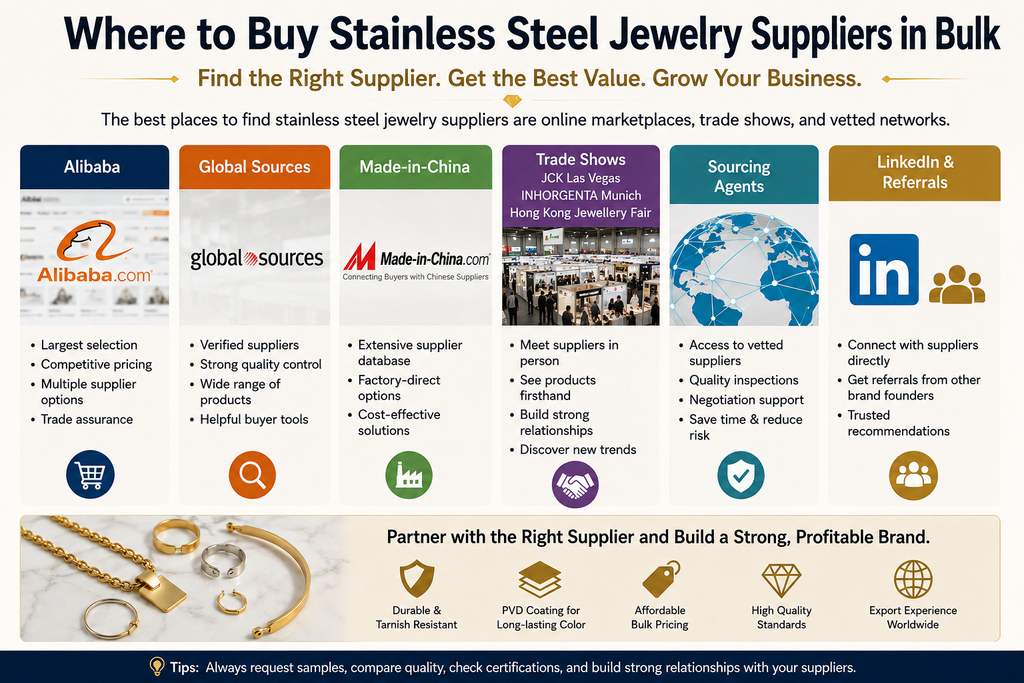
[The best places to find stainless steel jewelry suppliers are Alibaba, Global Sources, Made-in-China, and trade shows like JCK Las Vegas, INHORGENTA Munich, or Hong Kong Jewellery Fair.](https://inhorgenta.com/en/trade-fair/exhibitor-directory/)[^2] You can also find vetted suppliers through sourcing agents, LinkedIn, or referrals from other brand founders.
Finding a supplier is just the first step. The real challenge is finding one that fits your business model, your quality standard, and your MOQ requirement.
Online Platforms vs. Trade Shows
Here is a quick comparison of the most common ways brands find stainless steel jewelry suppliers:
| Channel | Am besten für | Profis | Nachteile |
|---|---|---|---|
| Alibaba | First-time sourcing | Large selection, easy RFQ | Quality varies widely |
| Global Sources | Mid-size buyers | Verified suppliers, trade show access | Fewer small factories |
| Made-in-China | Budget sourcing | Low price options | Less curation |
| Trade Shows (JCK, HK Fair) | Building relationships | Face-to-face, see samples in person | Travel cost, time-consuming |
| Niche OEM/ODM factories | Direct contact, professional context | Requires more outreach effort | |
| Sourcing Agents | Hands-off sourcing | Local expertise, quality control | Agency fees apply |
When I first started looking for suppliers, I made the mistake of just picking the cheapest option on Alibaba. The samples looked fine. But the bulk order had color inconsistencies and two batches had plating that faded within a month. That experience taught me to [always ask for compliance documents and request a video factory audit before placing a bulk order](https://www.oecd.org/en/publications/responsible-business-conduct-spotlights_03a75bf9-en/due-diligence-in-electronics-and-vehicle-manufacturing_993bb959-en.html)[^3].
If you want to skip the trial-and-error phase, working with [an OEM/ODM manufacturer that has BSCI, SGS, or ROHS documentation is a much safer starting point](https://environment.ec.europa.eu/topics/waste-and-recycling/rohs-directive_en)[^4]. At Zehore Jewelry, we provide compliance documents upon request and offer 7-day sampling so you can test quality before committing to bulk.
Where Can I Find Wholesale Stainless Steel Chains for Jewelry Making?
You need chains. Lots of them. But every supplier you contact either has a MOQ that is way too high or the chain quality is inconsistent between batches.
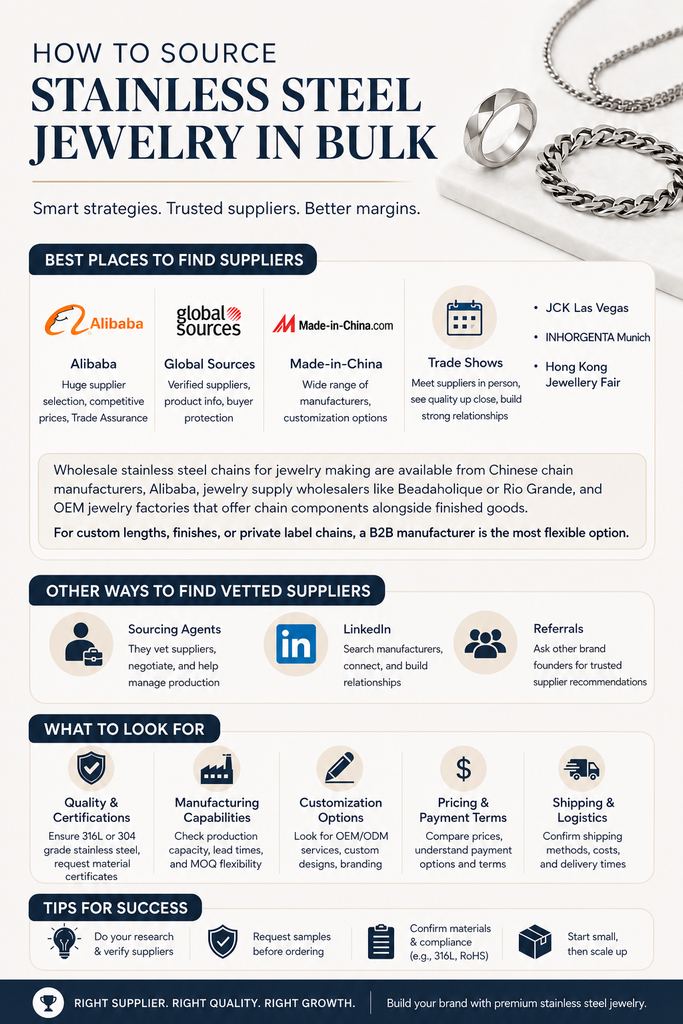
Wholesale stainless steel chains for jewelry making are available from Chinese chain manufacturers, Alibaba, jewelry supply wholesalers like Beadaholique or Rio Grande, and OEM jewelry factories that offer chain components alongside finished goods. For custom lengths, finishes, or private label chains, a B2B manufacturer is the most flexible option.
Chains are one of the most overlooked parts of a jewelry product. They look simple but they carry a huge amount of quality variation.
What to Look for When Buying Stainless Steel Chains in Bulk
Not all stainless steel chains are equal. Here are the key specs you should always confirm before ordering:
| Spec | Warum es wichtig ist |
|---|---|
| Steel grade (304 vs 316L) | [316L is more corrosion-resistant and better for skin contact](https://www.nist.gov/publications/influence-h2s-pitting-corrosion-316l-stainless-steel)[^5] |
| Plating type (PVD vs electroplating) | [PVD lasts longer and is more scratch-resistant](https://pmc.ncbi.nlm.nih.gov/articles/PMC10381906/)[^6] |
| Chain thickness (mm) | Affects durability and how it pairs with pendants |
| Link closure type | Affects strength and whether it will break under tension |
| Surface finish | Matte, polished, brushed — affects final product look |
| Lead/cadmium/nickel-free | Required for EU, US, and AU markets |
I have seen brands lose customers because their chain links opened up after a few wears, or because the gold tone on the chain faded faster than the pendant. These are fixable problems if you ask the right questions upfront.
If you are making necklaces or bracelets for retail, I strongly recommend sourcing chains from the same manufacturer producing your finished pieces. [This way the plating batches match, the metal tone is consistent](https://pmc.ncbi.nlm.nih.gov/articles/PMC10381906/)[^7], and you avoid the nightmare of two components that look slightly different under store lighting.
At Zehore Jewelry, we manufacture chains as standalone components and as part of finished jewelry. We support custom lengths, widths, and PVD finishes with low MOQ. Reach out to us if you want to request chain samples.
Where Can I Get Stainless Steel Jewelry?
You want stainless steel jewelry. But you are not sure whether to buy finished pieces off the shelf, order semi-custom, or go full custom. Each path has a very different cost and timeline.
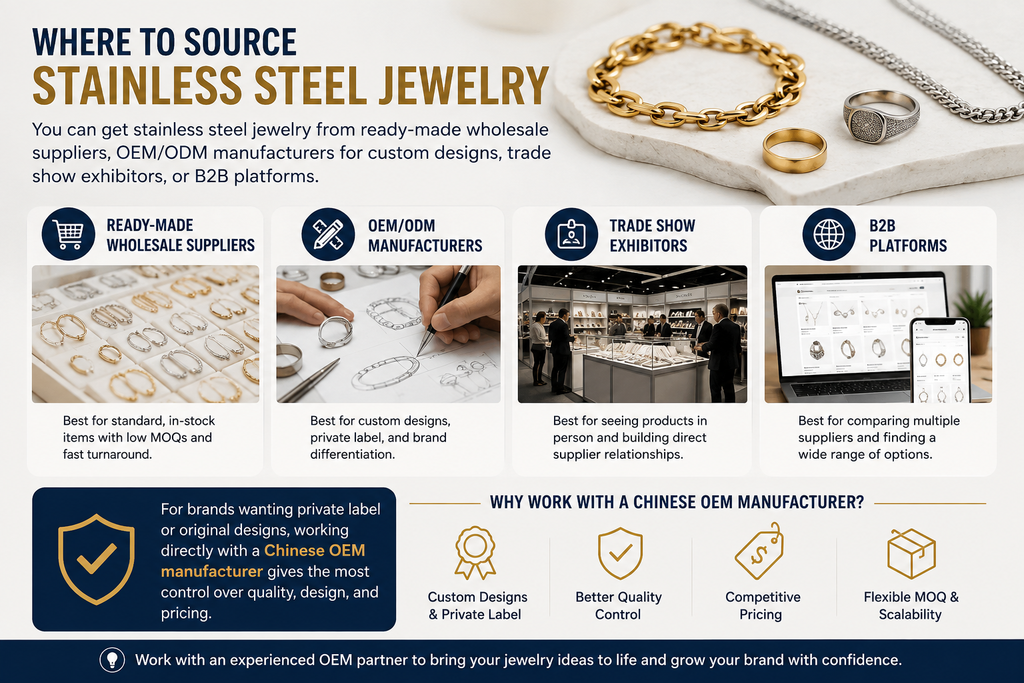
You can get stainless steel jewelry from ready-made wholesale suppliers, OEM/ODM manufacturers for custom designs, trade show exhibitors, or B2B platforms. For brands wanting private label or original designs, working directly with a Chinese OEM manufacturer gives the most control over quality, design, and pricing.
The right answer depends on what stage your business is at. Let me break it down.
Ready-Made vs. Custom Stainless Steel Jewelry
| Option | Am besten für | Vorlaufzeit | MOQ | Preis |
|---|---|---|---|---|
| Ready-made wholesale | Resellers, fast launch | 1-2 weeks | Low to medium | Lower per unit |
| Semi-custom (existing mold + your logo) | Private label brands | 2-3 weeks | Niedrig | Mittel |
| Full custom OEM/ODM | Original brand collections | 3-6 weeks | Low to medium | Higher per unit |
If you are just starting out, ready-made wholesale is the fastest path to market. You pick from existing designs, slap your label on the packaging, and go.
But if you are building a brand with a distinct aesthetic, you will hit a wall fast. Every competitor can order the same ready-made pieces. Your products will look identical to theirs.
[That is where OEM/ODM manufacturing makes a real difference. You get designs that are yours.](https://webcast.wipo.int/video/OTHER_WIPO_SYMPOSIUM_1_2019-11-26_AM_103138)[^8] Your customers cannot find the same piece from a competitor. And you control the quality spec.
I have worked with brands that started with ready-made wholesale and then transitioned to custom once they found their bestsellers. That is actually a smart strategy. Test fast, then invest in custom versions of what sells.
Where to Buy Stainless Steel Jewelry Wholesale?
You are ready to place a real order. You just need to know where to actually buy stainless steel jewelry wholesale without getting burned.
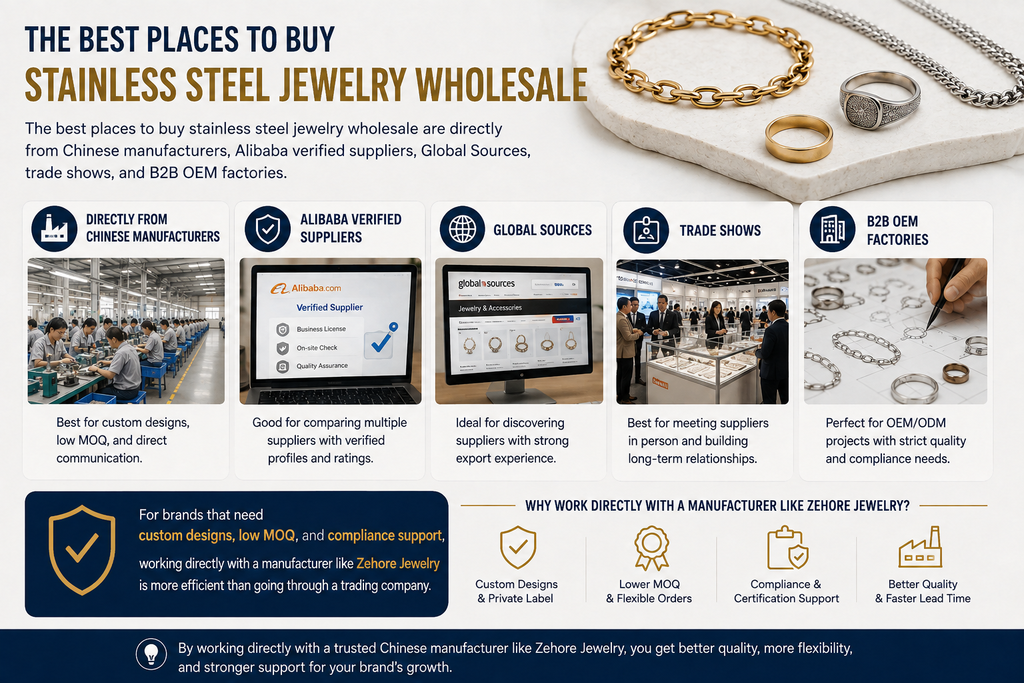
The best places to buy stainless steel jewelry wholesale are directly from Chinese manufacturers, Alibaba verified suppliers, Global Sources, trade shows, and B2B OEM factories. For brands that need custom designs, low MOQ, and compliance support, working directly with a manufacturer like Zehore Jewelry is more efficient than going through a trading company.
There is a big difference between buying from a factory and buying from a trading company. Both exist on Alibaba. Both can look professional. But they operate very differently.
Factory vs. Trading Company: Which One to Choose?
| Factor | Fabrik | Trading Company |
|---|---|---|
| Preis | Lower (no middleman) | Higher markup |
| MOQ | Usually more flexible | Depends on factory they use |
| Personalisierung | Full control | Limited, depends on factory |
| Kommunikation | Direct | Sometimes slower, indirect |
| Quality control | You can audit directly | Harder to verify |
| Compliance docs | Available from source | May be harder to obtain |
My recommendation: always try to work directly with a factory, especially if you are placing repeat orders or building a private label brand. The savings add up. And you have direct control over quality.
When you are evaluating a wholesale supplier, ask these questions before you pay anything:
- What is your MOQ for sampling vs. bulk?
- Can you provide REACH, ROHS, or SGS reports?
- What is your standard lead time for production?
- Do you support PVD plating?
- Can you do private label packaging?
Any serious manufacturer should be able to answer all of these without hesitation. If they stall or give vague answers, that is a red flag.
Where Can I Bulk Buy Jewelry Making Supplies?
You are not just buying finished pieces. You need findings, chains, clasps, charms, and raw materials. And you need t — [^1]: “Securing Medical Supply Chains in a Post-Pandemic World – OECD”, https://www.oecd.org/en/publications/securing-medical-supply-chains-in-a-post-pandemic-world_119c59d9-en/full-report/component-4.html. Research on global sourcing and supplier selection identifies cost, quality, delivery performance, and lead time as core outcomes affected by sourcing decisions. Evidence role: Supply-chain mechanism; source type: Peer-reviewed supply-chain or procurement research. Supports: The choice of sourcing channel can affect margins, product quality, and delivery timelines.. Scope note: The relative importance of each outcome varies by product, supplier, order volume, and contract structure. [^2]: “Exhibitor Directory”, https://inhorgenta.com/en/trade-fair/exhibitor-directory/. Platform and event directories document that the named B2B marketplaces and jewelry trade fairs connect commercial buyers with manufacturers, wholesalers, or exhibitors offering jewelry and related products. Evidence role: Channel identification; source type: Trade-fair directories, institutional event descriptions, and independent B2B-marketplace research. Supports: The named online marketplaces and trade fairs are established channels for locating jewelry suppliers.. Scope note: Their existence and supplier coverage do not establish that they are the “best” channels for every buyer or that every listed supplier is reliable. [^3]: “Due diligence in electronics and vehicle manufacturing – OECD”, https://www.oecd.org/en/publications/responsible-business-conduct-spotlights_03a75bf9-en/due-diligence-in-electronics-and-vehicle-manufacturing_993bb959-en.html. Supplier due-diligence frameworks recommend reviewing documentary evidence and assessing production facilities before contracting, because these measures can reveal compliance and operational risks that are not apparent from samples alone. Evidence role: Due-diligence practice; source type: Government, OECD, ISO, or academic procurement guidance. Supports: Reviewing compliance documents and conducting a factory assessment are useful checks before a bulk order.. Scope note: Documents and remote audits reduce information gaps but do not guarantee product conformity or prevent falsified records. [^4]: “RoHS Directive – Environment – European Commission”, https://environment.ec.europa.eu/topics/waste-and-recycling/rohs-directive_en. The referenced schemes serve different purposes: amfori BSCI addresses social-performance monitoring, RoHS restricts specified hazardous substances in certain electrical and electronic equipment, and SGS is a testing and inspection organization rather than a single product-quality certification. Evidence role: Compliance-framework clarification; source type: European Union, accreditation body, or standards-organization documentation. Supports: Compliance and audit documentation can inform supplier screening, although BSCI, SGS reports, and RoHS documentation are not interchangeable assurances of jewelry quality.. Scope note: Possessing related reports may aid due diligence, but it does not by itself prove jewelry quality, legal compliance in every market, or that a supplier is safer overall. [^5]: “Influence of H2S on the pitting corrosion of 316L stainless steel | NIST”, https://www.nist.gov/publications/influence-h2s-pitting-corrosion-316l-stainless-steel. Materials references describe molybdenum-bearing 316L stainless steel as generally more resistant than 304 to pitting and crevice corrosion in chloride-containing environments, and medical literature documents its use in devices that contact the body. Evidence role: Material-property comparison; source type: Materials-science paper, university reference, or medical-device standard. Supports: 316L generally offers greater corrosion resistance than 304 and is commonly selected for applications involving bodily contact.. Scope note: Suitability for prolonged skin contact also depends on surface finish, manufacturing residues, corrosion conditions, and nickel release; 316L is not universally hypoallergenic. [^6]: “PVD for Decorative Applications: A Review – PMC – NIH”, https://pmc.ncbi.nlm.nih.gov/articles/PMC10381906/. Tribology and coating studies report that appropriately deposited physical vapor deposition coatings can increase surface hardness, wear resistance, and scratch resistance relative to an uncoated substrate or some conventional decorative electroplated finishes. Evidence role: Coating-performance mechanism; source type: Peer-reviewed materials-science or surface-engineering paper. Supports: PVD coatings can provide greater wear and scratch resistance than conventional decorative electroplating.. Scope note: Service life depends on coating material, thickness, adhesion, substrate preparation, deposition parameters, and exposure conditions, so PVD is not automatically more durable in every product. [^7]: “PVD for Decorative Applications: A Review – PMC – NIH”, https://pmc.ncbi.nlm.nih.gov/articles/PMC10381906/. Color and appearance in decorative metallic coatings depend on coating composition, thickness, surface preparation, and process conditions; controlling these variables within a coordinated production process can reduce visible batch-to-batch variation. Evidence role: Manufacturing-process explanation; source type: Surface-engineering paper, color-measurement standard, or manufacturing-quality research. Supports: Coordinating plated components through the same controlled production process can help reduce differences in metal tone.. Scope note: Using one manufacturer may improve process coordination but does not guarantee a color match unless components are produced to shared specifications and verified instrumentally or visually. [^8]: “WIPO Symposium on Trade Secrets and Innovation: Day 2 (am)”, https://webcast.wipo.int/video/OTHER_WIPO_SYMPOSIUM_1_2019-11-26_AM_103138. Manufacturing literature distinguishes OEM arrangements, in which a supplier produces to a buyer’s specifications, from ODM arrangements, in which the supplier contributes or owns the underlying design; ownership and exclusivity depend on the contract and intellectual-property terms. Evidence role: Definition and contractual qualification; source type: Academic manufacturing research, intellectual-property guidance, or government trade guidance. Supports: OEM and ODM relationships can support customized products, but design ownership and exclusivity must be established contractually.. Scope note: Using an OEM or ODM does not automatically give the buyer ownership or exclusivity over a design, particularly when an ODM’s existing design is used.


 English
  Spanish
  French
  German