.png.webp)
Stainless Steel Jewelry — The Complete Pros and Cons Guide (With a Quality Checklist)
What Is Stainless Steel Jewelry, Really?
Scroll through Amazon’s earring section, and you’ll notice something: half the results are stainless steel. Walk into a fast-fashion accessory store, and the “hypoallergenic” rack is overwhelmingly stainless steel. The material has quietly taken over the affordable jewelry market in the last decade. Not because of a marketing campaign, but because of physics.
Stainless steel is an alloy — primarily iron, with a critical ingredient: at least 10.5% chromium. When chromium meets oxygen, it forms an invisible layer of chromium oxide on the surface of the metal, about 2 to 5 nanometers thick. This layer is self-healing: scratch it, and the newly exposed chromium immediately reacts with air to re-seal the barrier. That single mechanism explains every advantage stainless steel jewelry claims. Rust resistance, tarnish-proofing, and the reason it won’t turn your skin green all trace back to that nanometer-thin oxide film.
What most guides skip is this: “stainless steel” is not one material. Walk into a jewelry wholesaler’s factory, and you’ll see bins labeled 201, 304, and 316L. Three different grades, three very different levels of performance. Two are fine for jewelry. One should never touch human skin. On a product page, they all get labeled the same thing: “stainless steel.”
That distinction — between what the label says and what the metal actually is — is what this guide is about.
The Undeniable Pros of Stainless Steel Jewelry
Stainless steel didn’t become the dominant material in affordable jewelry by accident. Every advantage it offers maps directly to a frustration people have with traditional jewelry metals.
It’s genuinely hard to scratch. On the Mohs scale of mineral hardness, stainless steel sits around 5.5 to 6.5. That’s roughly comparable to a steel knife blade. Sterling silver? About 2.5 to 3. Pure gold? Also around 2.5. Your stainless steel ring will survive gym sessions, keyboard friction, and getting tossed into a bag with keys in a way a silver ring simply won’t. It’s not scratch-proof — nothing is — but it’s scratch-resistant enough for real life.
It doesn’t tarnish, rust, or turn colors. That chromium oxide layer is the hero here. Unlike silver, which reacts with sulfur in the air to form black silver sulfide (the reason you need a polishing cloth), stainless steel doesn’t oxidize in normal conditions. You can shower with it. You can sweat through a workout with it. You can wear it at the beach. Just rinse it afterward — 316L handles salt spray remarkably well thanks to its molybdenum content, but prolonged chlorine or seawater exposure can eventually dull any finish.
The price is hard to argue with. A well-made 316L stainless steel ring typically retails for $10 to $30. A comparable sterling silver ring: $30 to $100. A 10K or 14K gold ring: $150 to well over $500. That’s not a small gap. It’s an order-of-magnitude difference. For someone building an everyday jewelry collection, stainless steel means you can own ten pieces for the price of one silver piece.
If you have sensitive skin, this matters. The word “hypoallergenic” gets thrown around loosely, but with 316L stainless steel, there’s actual science behind it. Under the European standard EN 1811 — the test that measures nickel release from metal items contacting skin — 316L releases approximately 0.02 micrograms of nickel per square centimeter per week. The legal limit for prolonged skin contact is 0.5 µg/cm²/week. That means 316L releases roughly 25 times less nickel than what regulators consider safe. The nickel is there (10–14% of the alloy), but it’s locked inside the crystal structure by the chromium oxide passivation layer and the stabilizing effect of molybdenum. It doesn’t leach out.
Maintenance is almost nonexistent. Warm water, mild soap, a soft cloth. That’s your entire cleaning kit. No polishing compounds. No silver dips. No ultrasonic cleaner necessary (though you can use one). Compare that to silver, which needs regular polishing and ideally storage in anti-tarnish bags, and the lifestyle difference becomes obvious.
The finish options rival precious metals. Polished mirror, brushed matte, sand-blasted texture. Stainless steel takes all of them well. But the real step up is PVD (Physical Vapor Deposition) plating. In a vacuum chamber, metals like gold or titanium are vaporized and bonded to the steel surface at the atomic level. The resulting coating has a hardness of approximately 2,000 HV on the Vickers scale. That’s five to ten times harder than traditional electroplating, which sits around 200 to 800 HV. What this means in practice: a PVD gold-plated stainless steel necklace will stay gold for years, not weeks.
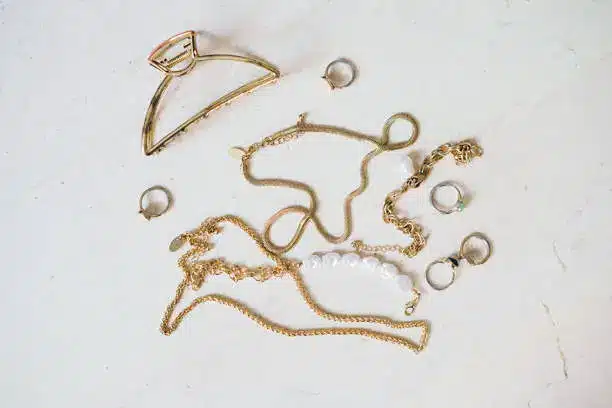
316L surgical-grade stainless steel releases 25 times less nickel than the legal limit for skin contact.
EN 1811 Certified Testing Standard
The Cons — What Nobody Tells You About Stainless Steel Jewelry
Every material has trade-offs. The honest ones to know about stainless steel fall into two categories: the classic downsides you’ll find in any guide, and the hidden ones almost nobody discusses.
The Classic Downsides (Weight, Resizing, and Perceived Value)
First, a correction: stainless steel isn’t actually heavier than silver or gold. Its density is about 7.9 g/cm³. Sterling silver is 10.5, and 14K gold is roughly 13 to 15. Stainless steel is actually lighter than both. The reputation for being “heavy” comes from the fact that stainless steel jewelry tends to be made in thicker, more substantial designs, while silver and gold pieces are often hollow or thinner to save material cost. A chunky stainless steel chain will have presence; a delicate stainless steel chain will feel almost weightless.
Resizing is a legitimate headache — but not for the reason most people think. The issue isn’t that stainless steel can’t be cut and re-joined. It’s that the melting point sits around 1,370 to 1,450°C, compared to silver’s 962°C and gold’s 1,064°C. Most neighborhood jewelry shops don’t have a laser welder capable of working at those temperatures. The practical fix is simple: measure your ring size carefully before ordering, or choose adjustable designs (open bands, chain extenders, sliding closures) if you’re unsure.
As for value: no, stainless steel jewelry won’t appreciate. It has no melt value to speak of, no commodities market trading price, and no pawn shop will give you anything for it. But a $20 ring that lasts five years has delivered its value. Not every possession needs to be an investment.
The Hidden Problem — Construction Quality Is Not Material Quality
Stainless steel as a material can last decades. But a piece of stainless steel Schmuck is only as strong as its weakest component. In cheap manufacturing, that component is rarely the metal itself.
The most common failure point is the clasp. A lobster claw clasp with a fatigued spring loses tension within months. A poorly welded jump ring — the small connector between clasp and chain — can fail at the weld point under surprisingly little force. These aren’t material failures. They’re manufacturing shortcuts.
Then there’s plating quality. PVD coating, done properly, deposits 0.5 to 1.0 microns of gold or other finish metal in a vacuum chamber, bonding it at the atomic level. A cheaper process called flash plating deposits as little as 0.03 microns. That’s essentially a tint, not a coating. Both look identical in a product photo. One lasts years. The other can show wear within a month. The industry standard for verifying this is a neutral salt spray test per ASTM B117. Quality PVD should survive 24 to 48 hours without visible color change. Flash plating won’t make it past the first few hours.
Finally, surface finish matters more than most buyers realize. A poorly polished stainless steel surface, viewed under magnification, is covered in microscopic grooves. Those grooves trap skin oils, soap residue, and dead skin cells. That’s why some people report their “stainless steel” jewelry leaving a dark residue on their skin. It’s not the metal reacting. It’s dirt accumulating in a rough surface that should have been polished smooth.
Buying stainless steel jewelry is like buying a car. A Toyota engine block can run for 300,000 miles, but if the assembly line forgot to torque the wheel nuts, you’re still stranded on the highway. Material quality and build quality are two separate decisions. Only one of them shows up in the product title.
The Material
- Chromium oxide self-healing protective layer
- 316L hardness 5.5–6.5 Mohs
- Molybdenum blocks chloride corrosion
- EN 1811 nickel release <0.02 µg
The Construction
- Weak spring in lobster clasp
- Flash plating at 0.03µm vs 0.5µm PVD
- Poor weld points failing under 3kg pull
- Rough surface trapping skin oils
The Fake Stainless Steel Problem
Read the one-star Amazon reviews for stainless steel jewelry, and a pattern emerges fast: “Wore them for two days and my ears swelled up.” “The gold color peeled off in a week.” “These say 316L but they’re magnetic — aren’t they supposed to be non-magnetic?”
This isn’t rare. It’s endemic. It happens because of two specific forms of misrepresentation.
The first is grade substitution. Grade 201 stainless steel costs roughly $150 less per ton than 304, and $300 to $500 less per ton than 316L. It contains only about 1 to 1.5% nickel (compared to 8–14% in 304/316L) and uses manganese as a partial substitute. That makes it prone to corrosion and far more likely to trigger skin reactions. Under EN 1811 testing, 201 stainless steel releases about 1.51 µg/cm²/week of nickel — triple the legal limit for skin contact. 316L, by comparison, releases 0.02. Yet on a product page, 201 gets labeled “stainless steel” just like everything else.
The second is plating fraud. True PVD vacuum plating requires expensive equipment: a vacuum chamber, vaporized target metals, precise process control. Electroplating just needs a chemical bath. The cost difference is significant, and the durability difference is massive. Both get sold as “gold-plated stainless steel.”
You don’t need a metallurgy lab to protect yourself. Three simple checks go a long way. First, a magnet test: 316L stainless steel is austenitic, meaning its crystal structure is essentially non-magnetic in the annealed state. A refrigerator magnet should not stick firmly to it (cold-worked areas like bent earring posts may show a very faint attraction). If the entire piece jumps to the magnet, you’re likely holding 201 or a lower-grade ferritic steel. Second, price is a signal: a 316L ring with proper PVD plating simply cannot be manufactured, shipped, and retailed profitably below $5. If the price seems impossibly low, the material is probably impossibly fake. Third, weight: real stainless steel has heft. A piece that feels suspiciously light and hollow is likely a thinner, lower-grade alloy.
Magnet Test
Grab a fridge magnet. If the piece snaps to it, it’s not 316L.
Weight Check
Real stainless steel has heft. A piece that feels like aluminum is suspect.
Patch Test
Wear on your wrist for 2 hours. Any redness or itching is your answer.
304 vs. 316L — The Grade Difference That Changes Everything
If you take away one technical detail from this guide, make it the difference between these two numbers.
| Dimension | 304 Stainless Steel | 316L-Edelstahl |
|---|---|---|
| Nickel content | 8–10.5% | 10–14% |
| Molybdenum | None | 2–3% |
| Salt/sweat resistance | Adequate | Excellent (molybdenum blocks chloride corrosion) |
| Skin reaction risk | Very low (passes EN 1811 for skin contact at ~0.08 µg/cm²/week) | Effectively zero (~0.02 µg/cm²/week — passes even for piercing use) |
| Magnetic response | Very weak (slightly magnetic after cold working) | Essentially non-magnetic |
| Relative cost | Baseline | About 1.3× to 1.5× the price of 304 |
The element that makes the difference is molybdenum. Those 2 to 3 percentage points allow 316L to resist pitting corrosion from chlorides. In plain English: salt, sweat, and seawater won’t eat microscopic holes in the surface. That’s why 316L is called “marine grade” and “surgical grade.” It’s the same alloy family used for boat fittings, medical implants, and body piercing jewelry.
Does this mean 304 is bad? No. 304 is food-grade stainless steel. It’s what your kitchen sink and cookware are made from. For someone who wears jewelry occasionally, has no known metal sensitivities, and isn’t exercising or swimming in it, 304 performs perfectly well. But if any of these apply — sensitive skin, daily wear, active lifestyle, coastal living — the 30 to 50% premium for 316L is the cheapest insurance you’ll ever buy against irritation and degradation.
How to Spot Quality Stainless Steel Jewelry — A No-Nonsense Checklist
Judging a piece of stainless steel jewelry doesn’t require a metallurgy degree. It requires asking the right questions at three distinct moments: before you click “buy,” when the package arrives, and after you’ve worn it for a month.
Before You Buy — What to Look for Online
You can’t touch the product through a screen, but you can read the signals that separate honest listings from marketing noise.
Start with the material description. “316L stainless steel” — with the grade number explicitly stated — is what you want to see. “Stainless steel” alone is vague but common. “Surgical steel” is a red flag: it’s not a regulated term, has no legal definition, and is routinely used to dress up 201-grade material. If the listing says only “high-quality metal” or “fashion alloy,” close the tab.
Price is the next filter. At current manufacturing economics, the simplest 316L ring — raw material, cutting, polishing, and basic packaging — has a factory-gate cost that makes a sub-$5 retail price mathematically impossible without grade substitution. A reasonable retail range for 316L: $10 to $30 for simple designs, $20 to $50 for pieces with genuine PVD gold plating or stone settings. Below $5, you are almost certainly not getting 316L.
Examine the product images critically. A quality listing shows close-ups of clasps, weld points, and the back of pendants. Not just styled lifestyle shots. PVD gold plating should appear uniform across the entire surface, with no lighter patches around edges or inside chain links. If every photo is a distant, softly lit model shot, the seller is hiding something. Probably surface finish quality.
Finally, scan the reviews with targeted keywords. Search within the reviews for “green,” “tarnish,” “allergic,” “broke,” and “peeling.” A few complaints are normal. A pattern of the same complaint across multiple reviews is diagnostic. One person saying “it turned my skin green” could be an individual reaction. Fifteen people saying it is a materials problem.
When It Arrives — Quick Tests You Can Do at Home
The package is in your hands. Before you commit to keeping it, run these checks.
The magnet test is your fastest screening tool. Grab a refrigerator magnet and touch it to the jewelry. If the piece clings firmly, as if it were a paperclip, you’re looking at a ferritic or martensitic steel — likely grade 201 or lower. True 316L in its annealed state is austenitic and essentially non-magnetic. One nuance: areas that have been heavily cold-worked (bent earring posts, stamped clasps) may develop a very faint magnetic attraction. A subtle tug, not a snap. That’s normal. A strong, full-piece magnetic grab is not.
Weight provides a secondary signal. Stainless steel has density. A chain that looks substantial in photos but feels like aluminum in your hand is suspect. Likely a thinner-gauge material or a lower-density alloy being passed off.
If you have known skin sensitivities, do a patch test. Wear the piece on the inside of your wrist for two hours. Any redness, itching, or warmth during that period is your answer. This test costs nothing, requires no tools, and is more personally relevant than any lab report.
After a Month — Signs You Bought the Real Deal
The first 30 days of wear reveal more about quality than any product description.
Positive signals: the color hasn’t shifted. PVD gold plating still looks uniform, with no silver-colored base metal showing through at edges or high-friction areas. Your skin shows no reaction at contact points. The clasp still closes with a satisfying click, not a mushy hesitation. The surface finish looks the same as the day you opened the box. A quick rinse with water restores it to like-new condition.
Warning signals: the plating has developed patchy discoloration or visible peeling. Your skin itches or reddens at the contact point, even intermittently. The clasp has lost spring tension or the hinge is developing play. The mirror polish has turned cloudy and won’t recover with cleaning.
The easiest way to bypass this entire quality-guessing game is to buy from retailers or brands that source from manufacturers who maintain verifiable third-party certifications. In the B2B jewelry world, reputable manufacturers — the factories that produce for established brands — operate under auditing frameworks like SGS, REACH, and BSCI, and maintain material test certificates that trace every batch of steel back to its mill of origin. That paper trail, from raw material to finished piece, is what separates real 316L from a label on a product page. If a seller can’t tell you what grade the steel is or which factory made it, that silence is information.
Stop guessing which pieces are real 316L. Start sourcing from a manufacturer that certifies every batch.
See Azone’s Quality CertificationsStainless Steel vs. Sterling Silver vs. Gold — An Honest Comparison
A spec sheet can tell you composition percentages. It can’t tell you which metal belongs on Ihr dresser. That decision depends on how you live, not just what the metal costs.
| Dimension | Stainless Steel (316L) | Sterling Silber (925) | Gold (10K–14K) |
|---|---|---|---|
| Scratch resistance | ⭐⭐⭐⭐⭐ | ⭐⭐ | ⭐⭐ |
| Tarnish resistance | ⭐⭐⭐⭐⭐ | ⭐⭐ (needs polishing) | ⭐⭐⭐⭐ |
| Price (ring) | $10–$30 | $30–$100 | $150–$500+ |
| Hypoallergen | ⭐⭐⭐⭐⭐ | ⭐⭐⭐ (contains copper) | ⭐⭐⭐⭐ (higher karats) |
| Wartung | Almost none | Regular polishing | Occasional cleaning |
| Water resistance | Fully waterproof | Avoid prolonged water contact | Tolerates water |
| Resale value | None | Mäßig | Hoch |
| Design intricacy | ⭐⭐⭐ | ⭐⭐⭐⭐⭐ | ⭐⭐⭐⭐⭐ |
Choose stainless steel if your jewelry needs to survive your life, not the other way around. If you exercise in your jewelry, shower in it, never remember to take it off, have sensitive skin, or are building a versatile collection on a budget — stainless steel is the rational choice. It’s not the cheap alternative to precious metals. It’s the practical alternative.
Choose sterling silver if craftsmanship and tradition matter more to you than low maintenance. Silver’s softness is also its strength: it allows hand-engraving, filigree, and intricate stone settings that stainless steel’s rigidity makes difficult. You’ll need to polish it periodically and store it carefully. What you get in return is a genuine precious metal with a warmth that steel can’t replicate.
Choose gold if the piece carries symbolic weight: an heirloom, a milestone, a once-in-a-lifetime purchase. Gold’s value retention, workability for fine jewelry, and cultural status are unmatched. It’s also, objectively, the most expensive option by a wide margin. That premium isn’t wrong. It’s just worth being honest about whether you’re paying for the metal or for what the metal represents.
Your wardrobe already works this way. Stainless steel is the T-shirt you reach for every day: affordable, comfortable, never the wrong choice. Silver is the button-down that needs ironing but looks sharper. Gold is the suit you wear twice a year.
Rostfreier Stahl
For everyday wear. Zero maintenance. Maximum durability.
Sterling Silber
For craftsmanship and tradition. Needs care, rewards with warmth.
Gold
For heirlooms and milestones. Investment-grade. Once in a lifetime.
Is Stainless Steel Jewelry Right for You? — The Final Verdict
By now, you have more information than 90% of stainless steel jewelry buyers. The question is what to do with it. Five questions will point you to your answer.
Do you want to think about jewelry maintenance? If the answer is “no, never,” stainless steel is your only realistic option among the three metals discussed here. Silver needs attention. Gold benefits from care. Stainless steel forgives neglect.
Does your skin react to metal? If yes, 316L stainless steel — specifically 316L, not generic “stainless steel” — is one of the safest materials you can wear. EN 1811 testing shows its nickel release rates sit dramatically below regulatory limits. But you must verify the grade. A “stainless steel” label without a grade number is not a guarantee.
What’s your actual budget? Under $30, stainless steel is the unambiguous winner. At that price point, silver is either plated (not solid) or extremely lightweight, and gold is not an option. Between $30 and $100, silver enters the conversation. Above $100, you’re choosing between high-end stainless steel with genuine gemstones and PVD finishing, or entry-level gold.
Is this for everyday wear or special occasions? Daily driver: stainless steel. Date night: either. Wedding day: the metal that means something to you, regardless of price.
Do you care about resale or heirloom value? If yes, gold is your answer. Stainless steel has no secondary market. That’s not a flaw. It’s just a category difference. Not everything you buy needs to hold trade-in value. Your sneakers don’t. Your phone doesn’t. Your everyday jewelry doesn’t need to either.
Stainless steel jewelry isn’t silver’s cheaper cousin. It’s an independent category with its own logic: maximum durability, minimal maintenance, honest pricing, and — when you know how to identify the real thing — remarkable quality. The catch is that you have to know what you’re looking at. A 316L ring from a certified manufacturer, with properly applied PVD plating and solid construction, is a genuinely excellent product. A mystery-alloy ring from a listings farm with “surgical steel” in the title and stock photos is a gamble.
The difference isn’t in the word “stainless steel.” It’s in everything that word doesn’t guarantee.
Talk to a 316L Specialist
20 years. 40,000 designs. Every batch traceable to its mill of origin.
Request Specifications
 English
  Spanish
  French
  German