.png.webp)
What is Custom Jewelry? The Ultimate Guide for Brands & Buyers (2026)
Decoding the manufacturing process, hidden costs, and how to scale bespoke designs without compromising quality or cash flow.
The word “custom” is thrown around loosely in the jewelry industry, leading many to search for the true custom jewelry meaning. Whether you are an independent brand founder looking to manufacture your first signature collection, or a buyer seeking a unique piece, navigating the gap between marketing buzzwords and manufacturing reality is critical.
Demystifying the Terminology: What Exactly is Custom Jewelry?
Before diving into timelines and budgets, if you are wondering what is bespoke jewelry compared to personalized pieces, we must draw a hard line between true custom manufacturing and simple modifications. Here is an industry truth most jewelers won’t tell you: nearly 80% of what is marketed as “custom jewelry” today is nothing more than swapping a stone in a mass-produced, pre-cast setting. If you don’t know the difference, you risk paying a massive bespoke premium for a generic catalog mold.
True Bespoke (From Scratch) vs. Personalized (Modified)
Personalized (Modified)
Think of this as ordering a sandwich from a set menu and swapping the sauce. It involves taking an existing, pre-fabricated die-struck or mass-cast setting and simply changing the center stone, altering the metal finish, or adding laser engraving. There is no exclusive 3D CAD file created for you.
True Bespoke (From Scratch)
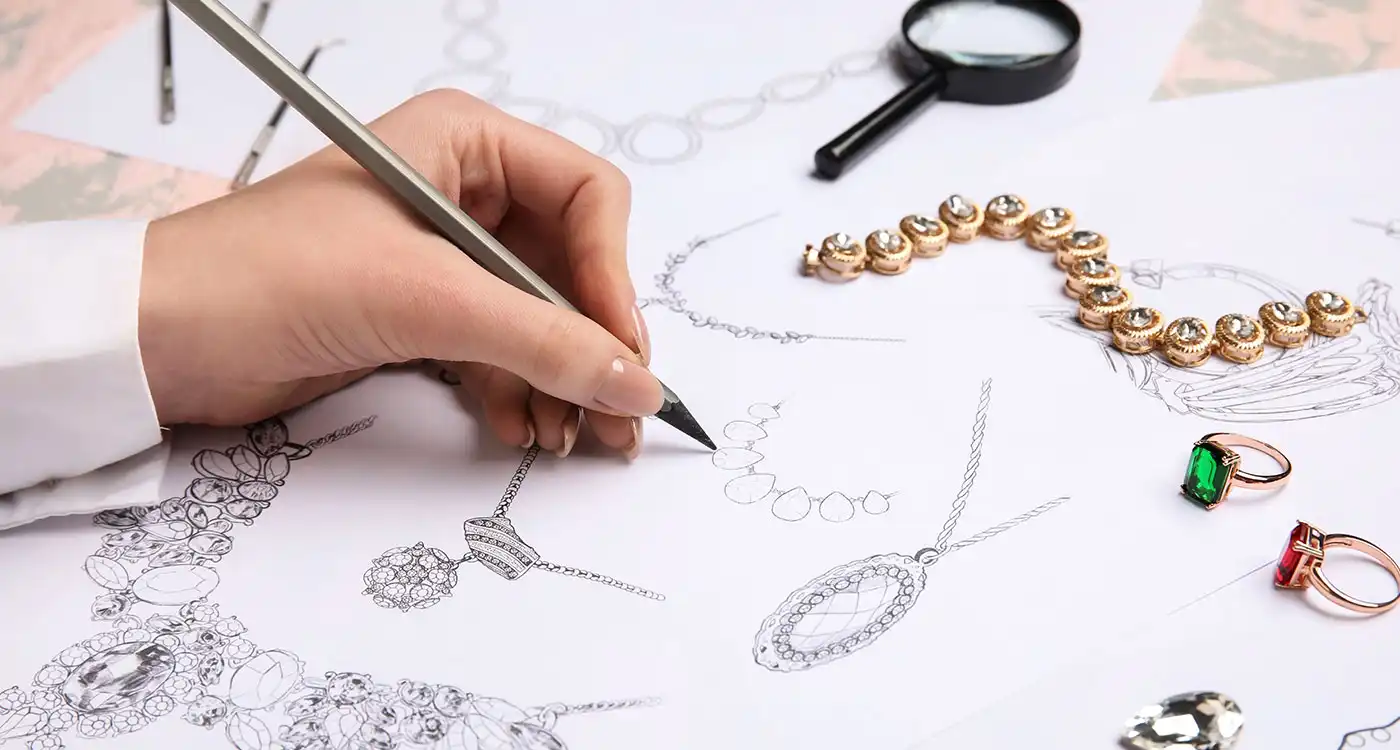
If you ask what is a bespoke ring, this is the equivalent of hiring a private chef to develop a new recipe. A true custom piece starts from a blank canvas. An exclusive 3D CAD model is engineered, considering the exact micrometer tolerances of your stones and structural integrity, followed by a dedicated wax mold. You own the intellectual property of this design.
Beyond Aesthetics: Why Choose True Custom Manufacturing?
If true bespoke manufacturing requires more time and budget than modifying an existing piece, why do top independent brands and discerning buyers insist on it? The answer lies in intellectual property, brand equity, and structural integrity.
- For B2B Brands (The Ultimate Moat): True bespoke manufacturing prevents your designs from being easily reverse-engineered. By owning the exclusive CAD files and master rubber molds, you build a genuine brand premium rather than competing on price with generic catalog items.
- For Discerning Consumers (Heirloom Re-design): It is the only safe way to breathe new life into vintage pieces. For example, extracting an Old European Cut diamond from a fragile antique brooch and engineering a modern, secure setting specifically calibrated for its exact geometry and girdle thickness.
- Uncompromising Quality Control: When starting from scratch, every prong thickness and metal density is mathematically calculated to match the wearer’s lifestyle, drastically reducing the risk of lost stones compared to force-fitting a gem into a pre-made cast.
The Ultimate Showdown: Custom vs. Personalized vs. Ready-Made
| Criteria | Ready-Made (Mass Produced) | Personalized (Modified) | True Custom (Bespoke) |
|---|---|---|---|
| Design Freedom | Zero. What you see is what you get. | Low. Limited to stone swaps and engraving. | Absolute. Dictated only by physics. |
| Timeline | Immediate (In-stock). | 1-2 Weeks. | 4-8 Weeks (Requires engineering). |
| Budget Impact | Most affordable (Economies of scale). | Moderate (Base price + modification fee). | Premium (Includes CAD, prototyping, and exclusive casting). |
| Return Policy | Usually 14-30 days. | Often final sale, or high restocking fee. | Final Sale. The mold is locked to your exact specifications. |
Behind the Bench: The Step-by-Step Custom Jewelry Process
The waiting period is often the most anxiety-inducing part of custom manufacturing. For those curious about how to make custom jewelry from scratch, let’s turn the black box into a glass house by exploring the actual factory floor process.
Inspiration and Initial Consultation (Week 1-2)
This is where concepts meet physical constraints. A professional manufacturer will immediately assess structural viability. For instance, evaluating the Mohs Hardness of your requested stones we routinely advise against using apatite or fluorite for daily-wear rings, guiding clients toward sapphire or spinel to prevent future liability.
3D CAD Modeling and Wax Prototyping (Week 3-4)
Your sketches are translated into a Computer-Aided Design (CAD). Beware of the “CAD Render Illusion.” Prongs and bands in a CAD render will always look thicker and bulkier than the final product. This is because engineers must mathematically add material to account for the metal that will be lost during sprue removal, filing, and final polishing.
Speed to Market & Manufacturing Feasibility
Many brands face catastrophic casting failures (e.g., snapped bands, casting porosity) when they hire independent designers who lack frontline factory experience. Their 3D files often ignore crucial tolerances. Working with a seasoned direct manufacturer eliminates this friction. At Azone Jewelry, our internal CAD engineers build designs with exact casting shrinkage parameters pre-calculated. Because everything is handled in-house, we compress complex casting prototyping to just 14 days, and laser-cut flat sampling to just 7 days, drastically accelerating your time-to-market.
Casting, Setting, and Polishing (Week 5-6+)
The approved wax or castable resin model is sprued to a wax tree and encased in a steel flask filled with investment plaster. It then undergoes a precise multi-hour burnout cycle in a kiln to completely melt and burn away the model, leaving a perfect negative cavity (the Lost-Wax Process). Molten gold or silver is then forced into this cavity using vacuum or centrifugal casting machines.
Expert quality control at this stage is ruthless: raw castings are inspected for gas porosity and shrinkage defects before moving to bench work including sprue removal, emerying, microscope-aided stone setting (often utilizing precision pneumatic gravers), and final rouge polishing.

Breaking Down the Black Box: How Much Does Custom Jewelry Really Cost?
Custom jewelry pricing shouldn’t be a mystery, but amateurs often make a fatal miscalculation by only weighing the final product. A reputable direct manufacturer uses a strict, transparent accounting formula that respects inescapable physics specifically, metal working loss:
Insider Truth: Why the 10-15% Loss? You aren’t just paying for the gold on your finger. You are paying for the raw material required to fill the sprue system, plus the microscopic metal particles ground away into dust during sprue removal, emerying, and rouge polishing. Transparent factories calculate this “working loss” upfront so you aren’t hit with hidden surcharges.
Scaling Your Brand: The “Low MOQ” Blueprint
For B2B buyers and designers, the biggest hurdle to launching custom lines isn’t the design it’s the crippling MOQ (Minimum Order Quantity) and inventory risk demanded by most factories. Furthermore, cheaper suppliers often fail to meet the rigorous environmental and human rights compliance required by European and North American markets.
You need “Scalable Bespoke.” Azone Jewelry bridges this gap by offering a highly flexible 50-100 piece MOQ for custom orders. More importantly, we protect your brand’s reputation with a stringent < 3% defect rate and full global compliance, including REACH, SGS, BSCI, and GRS certifications. You get top-tier European market quality without the crippling upfront capital.
The Double-Edged Sword: When You Should AVOID Custom Jewelry
Custom manufacturing is a partnership. It is not the right path for everyone. You should opt for ready-made pieces if:
- Your timeline is compressed. If you need a piece next week, custom is impossible without compromising the burnout cycle and structural integrity.
- You want a 1:1 replica of a luxury brand. Ethical manufacturers respect intellectual property and will not illegally duplicate copyrighted designs.
- You require an absolute return policy. Custom jewelry is an irreversible process tailored to your exact specifications. It cannot be returned to a display case.
The Client s Playbook: How to Prepare for Your First Consultation
Take control of the process by coming prepared. Here is what you need to bring to the table:
The Do’s
- Bring a “Dealbreaker” list (e.g., “I absolutely hate halo settings”).
- Know the exact ring size. Eternity bands (diamonds set 360 degrees around the shank) cannot be resized later.
- For B2B: Request a Non-Disclosure Agreement (NDA) to protect your IP before sharing technical packs.
The Don’ts
- Don’t expect a firm quote from just a sketch. Final costs depend on final CAD metal weights and the corresponding casting loss.
- Don’t ignore lifestyle factors. If the wearer works heavily with their hands, high-set peg prongs are a structural hazard.
Beyond the Box: Warranties, Appraisals, and Long-Term Care
The relationship doesn’t end at delivery. For high-value custom pieces, always request a detailed Retail Replacement Appraisal. This document must list the specific metal weight, CAD labor, and gem specifications (including GIA cert numbers) to secure proper jewelry insurance.
Functionally, custom pieces require maintenance. Schedule a structural inspection every 6-12 months for prong retipping and clasp checks. Furthermore, verify your manufacturer’s plating warranty. Premium factories producing high-end B2B fashion and demi-fine jewelry will stand by their work with a standard 1-2 year electroplating guarantee against abnormal oxidation and fading.
Frequently Asked Questions (FAQ)
Still have questions? Here are the most common inquiries we receive from first-time buyers and brand founders.
How much more does custom jewelry cost than regular jewelry?
Generally, true custom jewelry costs 10% to 20% more than a mass-produced piece of similar weight and material. The premium covers the dedicated hours of the CAD engineer, creating a one-off wax mold, and exclusive bench labor.
How long does it take to get a custom piece of jewelry made?
The standard timeline is 4 to 8 weeks from the initial consultation to final delivery. This includes 1-2 weeks for 3D modeling and revisions, and 3-4 weeks for physical casting, stone setting, and final polishing.
Is custom jewelry worth the investment?
Yes, if you want a 100% unique design, need to repurpose an old family heirloom, or are a brand establishing your own IP. However, if you are simply looking for a standard, trending style (like a basic solitaire ring), buying ready-made is more cost-effective.
Can I return custom-made jewelry?
Typically, no. Because a bespoke piece is engineered precisely to your exact ring size and specific stone dimensions, it cannot be easily resold. Custom jewelry is almost universally considered a final sale in the industry.
Ready to Bring Your Design to Life?
For Individual Buyers (1-of-1 Bespoke)
Perfect for heirloom redesigns and unique engagement rings. No MOQ. White-glove craftsmanship.
For Brand Founders (B2B Scalable)
Scale your brand with flexible 50-100 piece MOQs. Full REACH & GRS compliance. Strict quality control.


 English
  Spanish
  French
  German