.png.webp)
Is Gold Plated Jewelry Worth Anything? The Brutal Truth & Top Alternatives
Uncovering the real value of plated metals, the hidden costs of refining, and what truly matters for your jewelry business.
The Brutal Truth: Does Gold Plated Jewelry Have Any Resale Value?
Let’s cut straight to the chase: if you are walking into a pawn shop or a “cash for gold” storefront asking, “is gold plated jewelry worth anything?”—the financial answer is effectively zero. It is a harsh reality for many who inherit vintage-looking pieces or attempt to clear out their jewelry boxes.
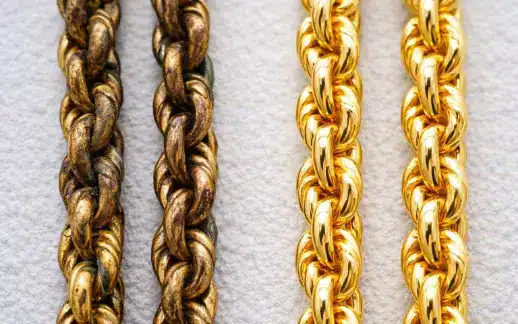
Even with proper care, standard electroplating eventually wears thin, revealing the dull base metal core beneath.
Unlike solid gold, which trades based on the daily spot price, many wonder if is 18k gold plated jewelry worth anything or if is 14k gold plated jewelry worth anything. From a raw material perspective, gold-plated jewelry consists of a base metal core covered by a microscopically thin layer of gold. Pawnbrokers evaluate items based on “melt value.” Because the actual gold content is so minimal—even in cases where is 24k gold plated jewelry worth anything—it holds no viable financial equity as a raw material.
Why Refining Gold Plated Items is a Losing Game
A common objection from determined owners is, “But there is real gold on it! Can’t I just melt it down or extract it?” Whether it is 18 karat or is 24 karat gold plated jewelry worth anything, from a chemical and economic standpoint, the answer is a resounding no.
To extract that microscopic layer of gold, refineries must use dangerous and highly corrosive chemicals, such as Aqua Regia, or utilize reverse electroplating. This applies even when questioning is 18 karat gold plated jewelry worth anything.
The Brutal Math of Refining: Assume you have a 50-gram brass necklace with a standard 0.5-micron gold plate. The actual weight of the gold might be less than 0.05 grams—worth perhaps $3 to $4 on the market. However, the labor, the specialized chemical reagents, and the strict environmental disposal costs for the toxic byproducts will cost upwards of $40 to $50.
The cost to extract the gold far exceeds the value of the gold itself. It is a losing game that no commercial refinery is willing to play, making people realize is gold-plated jewelry worth anything in terms of scrap value.
FTC Standards vs. Flash Plating: The Micron Reality
If the gold layer is so thin, exactly how thin are we talking? According to the U.S. Federal Trade Commission (FTC), for an item to be legally marketed as “Gold Plated,” the gold layer must be at least 0.5 microns thick. To put that in perspective, a single human hair is about 70 microns thick.
Worse yet, the majority of cheap fast-fashion jewelry—regardless of if it claims is 18k gold-plated jewelry worth anything—doesn’t even meet this standard. They utilize Flash Plating, which deposits a layer as thin as 0.175 microns. This is practically a breath of gold that will rub off onto your skin within weeks.
The Anatomy of a Plated Piece
To truly understand plating quality, imagine a cross-section of your jewelry. A well-manufactured piece consists of three distinct layers:
- The Core (Base Metal): Usually brass or copper (for standard electroplating), providing the weight and structural integrity.
- The Barrier Layer: A crucial middle layer (often nickel or palladium) that prevents the base metal from reacting with and bleeding into the gold.
- The Gold Layer: The final aesthetic finish, which determines is gold plated jewelry worth anything? In terms of longevity.
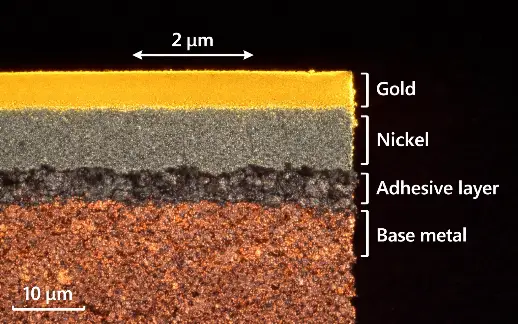
Microscopic cross-section of high-quality plating, showing the essential barrier layer that prevents base metal migration and tarnishing.
The Exception to the Rule: When DOES Gold Plated Jewelry Hold Value?
While the intrinsic metal value might be practically zero, there are specific scenarios where gold-plated jewelry is highly sought after and commands a premium price.
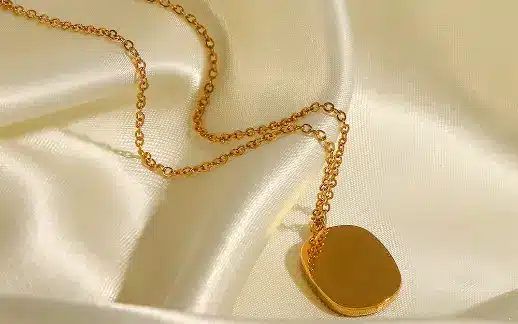
Vintage designer pieces, like this necklace, retain high value due to brand heritage and unique design, not the melt weight of the gold plating.
The Vintage Designer Premium (Chanel, Dior, Givenchy)
In the secondary market, the name stamped on the back of the piece matters exponentially more than the metal it’s made of. Heavy gold-plated pieces from luxury houses are highly collectible. Buyers are paying for the brand’s heritage, the out-of-production bold designs, and the “Vintage” entry ticket—not the scrap gold value.
Antique vs. Modern Plated Pieces
Historical context also creates value. Victorian or Edwardian-era pieces often utilized “Pinchbeck” or early, incredibly thick gilding techniques. If an antique piece has survived a century without losing its color, it possesses a “survival bias” and historical craftsmanship that antique dealers prize highly.
The Ultimate Hierarchy of Gold Alternatives (Plated, PVD, Filled & Vermeil)
If standard gold plating isn’t a long-term investment, what are the alternatives for those who want the look of solid gold without the staggering price tag? Here is the complete hierarchy of gold alternatives to help guide your budget and manufacturing decisions.
| Material Type | Core Metal | Gold Content/Thickness | Price Tier | Durability |
|---|---|---|---|---|
| Gold Plated | Brass, Copper | 0.5 Microns (FTC min) | $ | Seasonal (depends on care) |
| PVD on Stainless Steel | 316L Surgical Steel | Molecular TiN + Gold Bond | $$ | Excellent (Water/Sweat proof) |
| Gold Vermeil | 925 Sterling Silver | 2.5 Microns (Legal req) | $$$ | High (Reveals premium silver if worn) |
| Gold Filled | Jeweler’s Brass | 1/20th (5%) of total weight | $$$ | Decades (Heat bonded) |
Standard Gold Plated (The Entry Level)
This is the most common and accessible tier. Utilizing a base of brass or copper, it receives a standard electroplated gold layer. High-quality standard plating (0.5 to 1.0 microns) with a proper barrier layer offers excellent seasonal durability and allows for highly intricate, trend-driven designs at an unbeatable price point.
PVD Gold on Stainless Steel (The Waterproof Champion)
For everyday wear, standard electroplating has a superior rival: Physical Vapor Deposition (PVD) on 316L Stainless Steel. Instead of dipping the metal in a chemical bath, PVD bonds the gold material at a molecular level in a vacuum environment. Crucially, high-end PVD utilizes a Titanium Nitride (TiN) ceramic hardening layer underneath or alloyed with the gold. This creates a finish that is up to 10 times more durable, highly waterproof, and sweat-resistant compared to traditional plating. It is the undisputed champion for fitness and daily-wear jewelry.
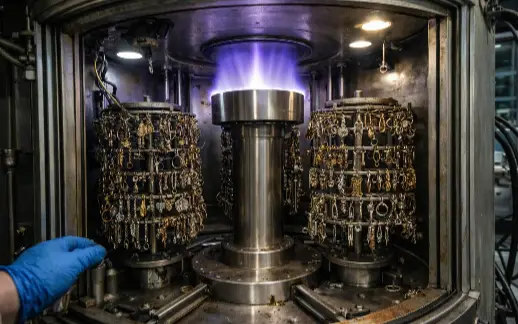
Inside the PVD chamber, the gold is molecularly bonded with a titanium nitride hardening layer, achieving the ultimate durability for stainless steel jewelry.
Gold Vermeil & Gold Filled (The Premium Alternatives)
Gold Vermeil (pronounced “ver-may”) uses a 925 Sterling Silver core with a heavy 2.5-micron gold plate. It acts as a double-insurance policy: even if the gold eventually wears down, you are left with a hypoallergenic precious metal. However, unlike green copper stains, be aware that exposed 925 silver will eventually oxidize and tarnish, turning black, requiring regular polishing to maintain its luster. Gold-filled jewelry mechanically bonds a thick sheet of solid gold (5% of total weight) to a brass core using extreme heat and pressure, lasting decades.
How to Identify Fake vs. Valuable Plated Jewelry
Common Plating Stamps
- GP / GEP: Gold Plated / Gold Electroplated.
- HGE / HGP: Heavy Gold Electroplate (usually around 2.5 microns).
- GF: Gold Filled.
- 925: Indicates a Sterling Silver base. If the piece is gold-toned, it is gold-plated silver, but this stamp alone does not guarantee the thick 2.5-micron Vermeil standard.
Red Flags & The Magnet Test Reality
A quick way to spot low-grade industrial metals is the Magnet Test. Precious metals and high-quality brass/copper bases are non-magnetic. If your jewelry aggressively leaps to a strong magnet, the core is likely a cheap iron alloy that will eventually rust.
A faint pull is normal for cold-worked 316L stainless steel; a powerful cling indicates a cheap iron core.
Note for Professionals: Do not confuse cheap magnetic iron with premium 316L Stainless Steel. While high-grade 316L Surgical Steel is generally non-magnetic, it can sometimes exhibit a very faint magnetic pull due to cold-working and forming during the manufacturing process. A faint pull on a stainless steel piece is normal physics; a violent leap to the magnet indicates cheap iron.
The True “Worth”: Brand Reputation & Margin Protection
For end-consumers, the value of plated jewelry lies in its “Cost Per Wear.” But for B2B jewelry brands, wholesalers, and e-commerce sellers, the true “worth” of gold-plated jewelry is measured by return rates, customer lifetime value, and brand reputation.
When you source cheap, flash-plated jewelry, the upfront savings are instantly wiped out by the hidden costs of processing returns, refunding angry customers whose skin turned green, and the permanent damage to your brand’s trust.
Elevate Your Brand with Ethical, High-Quality Manufacturing
This is where Azone Jewelry changes the equation. As a manufacturer with over 20 years of expertise, we don’t just plate jewelry; we engineer it. We strictly enforce rigorous quality controls, including electroplating thickness measurements, artificial sweat tests, and salt spray tests, ensuring a defect rate strictly under 3%.
We provide a solid 1 to 2-year electroplating warranty to protect your margins. Furthermore, modern consumers demand ethical sourcing. With our GRS, BSCI, and SMETA certifications, and adherence to global REACH standards, partnering with Azone means building a brand that is both profitable and responsible.
Request a Plating Quality Sample Kit


 English
  Spanish
  French
  German