.png.webp)
How to Reduce Risk on Large Stainless Steel Jewelry Orders?
Placing a large jewelry order feels exciting — until things go wrong. Fading, allergic reactions, and quality gaps between samples and bulk can cost you thousands.
The best way to reduce risk on large stainless steel jewelry orders is to verify material grades, request pre-production samples, confirm plating standards, and work with a supplier who provides compliance documents like REACH and ROHS reports before committing to bulk production.

Before we get into the risk management side, it helps to understand the material itself. If you know exactly what stainless steel jewelry can and cannot do, you will make much smarter sourcing decisions. Let me walk you through the most common questions buyers ask — and what the answers actually mean for your business.
What Are the Downsides of Wearing Stainless Steel Jewelry?
You have heard that stainless steel is tough. But no material is perfect, and knowing the downsides helps you set the right expectations for your customers.
The main downsides of stainless steel jewelry include limited resizability, a heavier feel compared to gold-filled pieces, potential for surface scratches over time, and the fact that lower-grade stainless steel may still cause reactions in people with nickel sensitivity.

The Downsides That Actually Matter to Buyers
Let me be direct. Most of the "downsides" you read online are minor. But a few of them are real sourcing risks.
| Downside | How It Affects Your Business | What You Can Do |
|---|---|---|
| Surface scratching | Returns and complaints from end customers | Use IP (ion plating) or PVD coating for better scratch resistance |
| Heavier weight | Not ideal for lightweight earring lines | Choose thinner gauges or hollow designs |
| Nickel content in lower grades | Allergy complaints, compliance failures in EU | Specify 316L or 316 grade, request SGS nickel release test |
| Hard to resize | Limits ring customization options | Offer open-band or adjustable designs instead |
| Cold metallic feel | Some customers prefer warmer materials | Pair with natural stones or pearls to soften the look |
The biggest risk I see brands overlook is the nickel issue. In the EU, jewelry must comply with the REACH regulation, which limits nickel release to 0.2 μg/cm²/week for items in prolonged skin contact. If your supplier is not testing for this, you are exposed.
I once worked with a brand that launched a ring collection without checking the nickel release data. Two months in, they were dealing with customer complaints and a compliance flag from their EU retailer. That was an expensive lesson. The fix is simple: ask for the test report before you place the bulk order.
If you are building a brand that positions itself on skin-safe, hypoallergenic jewelry, this is non-negotiable. At Zehore Jewelry, we provide SGS/ROHS/REACH compliance documents upon request — so you have the paperwork before you commit.
Is 316L Stainless Steel Safe to Wear as Jewelry?
This is one of the most searched questions in the jewelry sourcing space. And it matters more than most buyers realize.
Yes, 316L stainless steel is widely considered safe for jewelry. It is a medical-grade alloy with very low carbon content and high corrosion resistance. It releases minimal nickel under normal wear conditions1, making it one of the most hypoallergenic metals used in fashion jewelry today.

Why 316L Is the Industry Standard — and What to Watch For
316L is not just marketing language. The "L" stands for low carbon, which reduces the risk of carbide precipitation during welding. This makes the metal more stable, more corrosion-resistant, and less reactive against skin.
Here is a quick breakdown of how 316L compares to other common jewelry metals:
| Material | Nickel Content | Corrosion Resistance | Hypoallergenic Rating | Price Range |
|---|---|---|---|---|
| 316L Stainless Steel | Very low (tightly bound) | Excellent | High | Low–Mid |
| 304 Stainless Steel | Higher, less stable | Good | Moderate | Low |
| Sterling Silver (.925) | None | Moderate | High | Mid |
| Brass (unplated) | None, but zinc alloys vary | Low | Low–Moderate | Low |
| Titanium | None | Excellent | Very High | Mid–High |
The key word here is "tightly bound." In 316L, nickel is alloyed into the structure, not sitting on the surface. This is why it performs so differently from nickel-plated brass, where nickel sits on top and wears off over time.
That said, 316L is not risk-free for everyone. People with severe nickel allergies may still react, even to medical-grade steel. If your target customer has very sensitive skin, you may want to offer titanium or solid gold options alongside your stainless steel line.
For most DTC jewelry brands selling waterproof, everyday wear collections, 316L is the right call. It is durable, affordable, and compliant with major market regulations when tested properly. The mistake is assuming all suppliers use genuine 316L. Always ask for a material certificate and an independent test report. Do not rely on verbal confirmation alone.
Can I Wear Stainless Steel Jewelry 24-7?
Your customers want jewelry they do not have to think about. That is the whole appeal of the "waterproof jewelry" category. But is it actually safe to wear stainless steel around the clock?
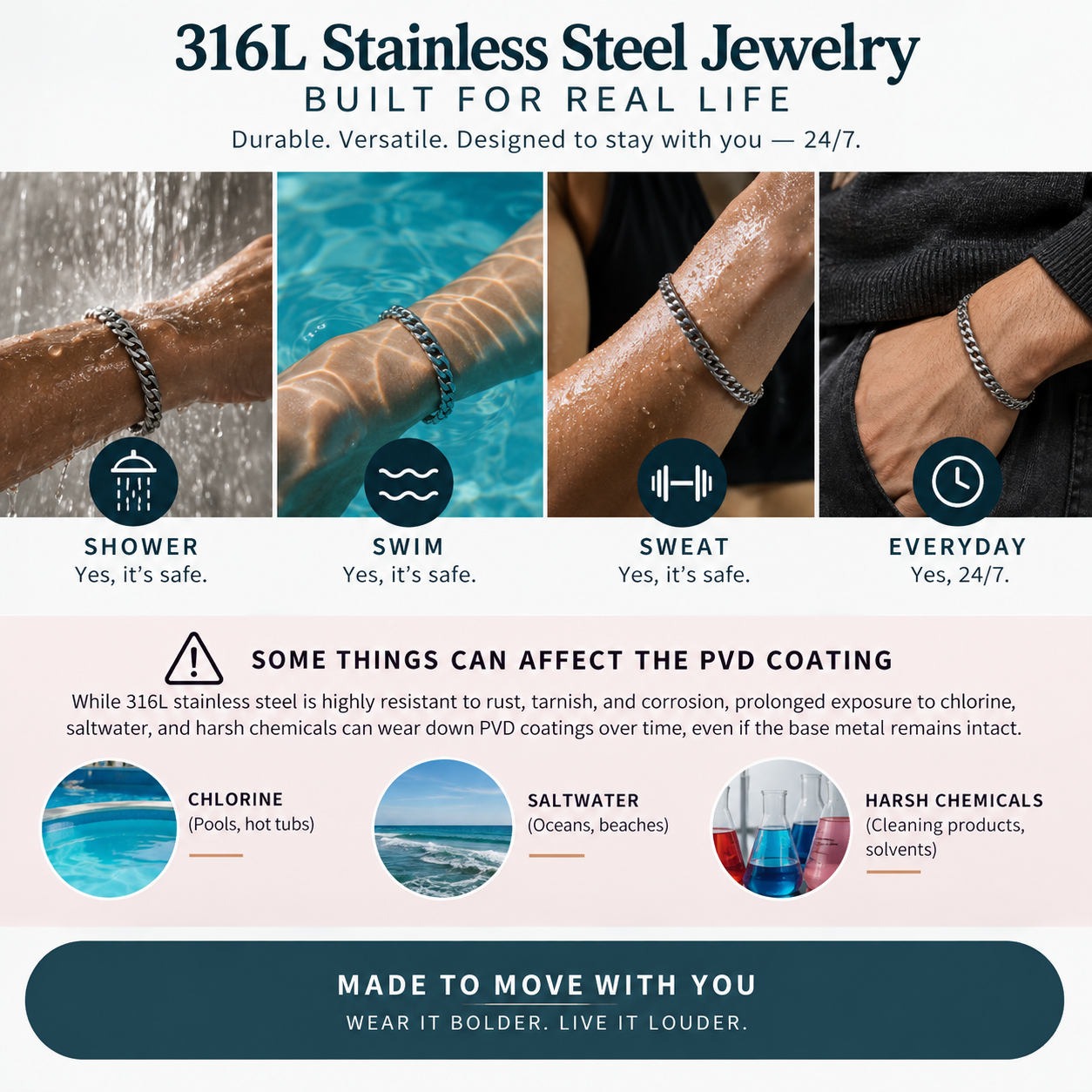
Yes, high-quality 316L stainless steel jewelry can be worn 24/7 in most conditions, including showering, swimming, and sweating. However, prolonged exposure to chlorine, saltwater, and harsh chemicals can degrade PVD coatings over time, even if the base metal remains intact.
What "Waterproof" Really Means in Practice
This is where a lot of brands get into trouble with their customers. They market jewelry as "waterproof" without explaining the nuances. Then customers wear their pieces in a chlorine pool every day for six months and wonder why the gold finish looks dull.
Let me break it down clearly:
| Condition | 316L Base Metal | PVD Gold Coating |
|---|---|---|
| Daily shower | ✅ Safe | ✅ Safe |
| Sweat / gym | ✅ Safe | ✅ Safe |
| Saltwater (occasional) | ✅ Safe | ⚠️ Rinse after |
| Chlorine pool (frequent) | ✅ Safe | ⚠️ Accelerates wear |
| Perfume / lotion contact | ✅ Safe | ⚠️ Avoid direct contact |
| Harsh cleaning chemicals | ✅ Safe | ❌ Avoid |
The base metal holds up. The coating is where the real-world limits are.
PVD (Physical Vapor Deposition) coating is the best option for long-lasting color on stainless steel. It is much more durable than standard electroplating. But no coating lasts forever under extreme conditions.
When I talk to brand founders about this, I always say the same thing: be honest in your product copy. Tell customers the jewelry is waterproof for everyday wear, and explain what to avoid. That transparency reduces returns and builds trust.
From a sourcing perspective, the question you should ask your supplier is: what is the PVD coating thickness? A good standard is 0.3–0.5 microns for gold PVD on stainless steel. Ask for the spec sheet. If a supplier cannot provide it, that is a red flag.
Is It Worth Buying Stainless Steel Jewelry?
This is the big-picture question. Whether you are a buyer building a product line or a brand owner deciding on materials, the answer affects your entire strategy.
Yes, stainless steel jewelry is worth buying for most mid-range and accessible premium jewelry brands. It offers the best balance of durability, affordability, compliance, and design flexibility — especially for waterproof and everyday wear collections targeting the $20–$150 retail price range.

How Stainless Steel Stacks Up as a Business Decision
This is not just a consumer question. It is a sourcing question. And the answer looks different depending on what kind of brand you are building.
| Brand Type | Is Stainless Steel a Good Fit? | Why |
|---|---|---|
| Waterproof / everyday jewelry brand | ✅ Excellent fit | Durable, water-resistant, low return rate |
| Minimalist DTC brand | ✅ Good fit | Clean finish, consistent quality, scalable |
| Demi-fine / accessible luxury brand | ✅ Good fit | PVD gold looks premium at a lower cost |
| Fine jewelry brand (solid gold / platinum) | ❌ Not a fit | Different customer expectations |
| Sustainable / eco-conscious brand | ✅ Good fit | Recyclable, lead-free, REACH-compliant options available |
From a margin perspective, stainless steel is hard to beat. The raw material cost is low. The production is scalable. The defect rate, when working with a good manufacturer, is much lower than brass or zinc alloy.
The brands I see winning in this space are the ones who treat stainless steel seriously — not as a cheap alternative, but as a material with real performance advantages. They invest in good PVD coatings, they test their products, and they tell a clear story to their customers about why their jewelry lasts.
If you are sourcing for the first time or switching suppliers, start with a small trial order. Test the pieces yourself. Wear them in the shower. Put them in a sweat test. Check the plating under good lighting after two weeks. That real-world testing tells you more than any spec sheet.
At Zehore Jewelry, we offer 7-day sampling with low MOQ so you can run that test before committing to bulk. That is exactly how you reduce risk on large orders — you validate the product first.
FAQs
Q1: What is the minimum order quantity for stainless steel jewelry from a manufacturer like Zehore?
A1: Most reputable stainless steel jewelry manufacturers offer low MOQ options, typically starting from 10–50 pieces per style for sampling. Bulk production MOQs usually start from 100–300 pieces per style depending on complexity.
Q2: How do I verify that my supplier is actually using 316L stainless steel?
A2: Ask for a material certificate from the steel mill and an independent third-party test report (SGS, Intertek, or BV). Do not rely on verbal confirmation. A trustworthy supplier will provide documentation without hesitation.
Q3: What compliance documents should I request for EU or US markets?
A3: For the EU, request a REACH compliance report (especially nickel release test). For the US, request a ROHS or California Prop 65 report. BSCI or GRS certification is useful if your brand focuses on ethical sourcing.
Q4: How long does PVD gold plating last on stainless steel jewelry?
A4: With proper care, PVD gold plating on 316L stainless steel can last 2–5 years under everyday wear conditions. The lifespan depends on coating thickness, wear habits, and chemical exposure. Always ask your supplier for the PVD coating thickness spec.
Q5: Can I get custom designs with my own logo on stainless steel jewelry?
A5: Yes. Most OEM/ODM manufacturers offer private label and custom design services for stainless steel jewelry. Look for suppliers with in-house 3D design support and fast sampling turnaround — ideally within 7 days — to keep your product development timeline on track.
Conclusion
Stainless steel jewelry is one of the smartest material choices for modern jewelry brands — but only when you source it right. Verify the grade, test before bulk, and always get the compliance documents.
-
"Nickel – Wikipedia", https://en.wikipedia.org/wiki/Nickel. 316L stainless steel has been shown to release significantly low levels of nickel, often below the threshold that triggers allergic reactions. Evidence role: statistic; source type: research paper. Supports: 316L stainless steel releases minimal nickel under normal wear conditions, making it hypoallergenic.. Scope note: Individual sensitivity may still result in allergic responses. ↩


 English
  Spanish
  French
  German