.png.webp)
What Is Vermeil Jewelry? A Complete Guide to Gold Vermeil
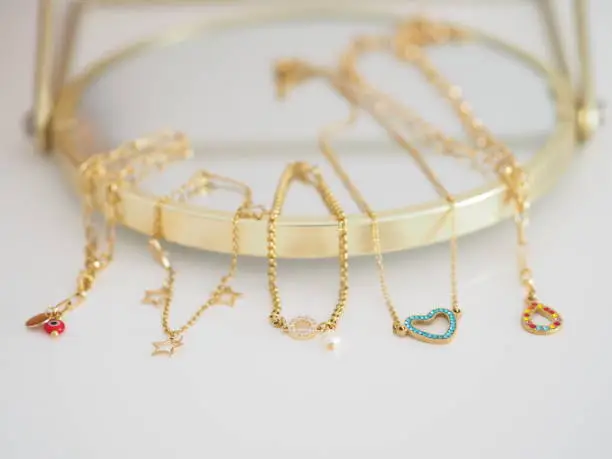
Vermeil (pronounced ver-may, from the French word for “gilded silver”) is a premium category of gold-plated jewelry defined by one non-negotiable distinction: the base metal must be plata de ley. Unlike ordinary gold-plated pieces — where a whisper-thin layer of gold sits on top of cheap brass or nickel — vermeil pairs a substantial layer of genuine karat gold with a .925 sterling silver core.
Think of it as the bridge between costume jewelry and fine jewelry. It delivers the warm, luminous look of solid gold at a fraction of the price, but with a foundation of real precious metal underneath. When the gold eventually wears — and it will, as all plated surfaces do — what you’ll find underneath is sterling silver, not green-turning brass. That single distinction is what puts vermeil in its own category on the jewelry quality spectrum. It’s the reason this word matters when you’re shopping.
The FTC Standards: Three Rules That Define Real Vermeil
In the United States, “vermeil” is not a marketing word. It’s a legally regulated label under the Federal Trade Commission’s Guides for the Jewelry, Precious Metals, and Pewter Industries (16 CFR Part 23). For a piece to legally carry the vermeil name, it must satisfy all three of these requirements:
| FTC Requirement | Specific Standard | Por qué es importante |
|---|---|---|
| Base metálica | Must be sterling silver (92.5% pure silver) | Excludes brass, copper, and nickel bases — the metals most likely to trigger skin reactions or turn green |
| Gold Karat | At least 10K (14K, 18K, and 24K are common) | 10K is the legal floor; higher-karat vermeil delivers a richer gold color and greater intrinsic value |
| Gold Thickness | Minimum 2.5 microns across all significant surfaces | This is the “reasonable durability” threshold. At about 1/10,000 of an inch, 2.5 microns is what separates vermeil from generic flash-plating that can wear off in weeks |
A fourth, less-cited rule is equally important: the FTC prohibits calling a piece “vermeil” if a layer of nickel or another base metal sits between the silver and the gold, unless that intermediate layer is explicitly disclosed. This prevents manufacturers from cutting costs with a nickel buffer that defeats vermeil’s hypoallergenic advantage.
How to protect yourself as a buyer: Look for a “925” stamp on the piece. Legitimate vermeil almost always carries sterling silver hallmarks alongside the brand mark. If a seller uses the word “vermeil” but cannot tell you the gold thickness in microns, treat that as a red flag. Quality-minded manufacturers typically plate to 3–5 microns, comfortably exceeding the legal minimum.
How Vermeil Jewelry Is Manufactured
Genuine vermeil isn’t something a small workshop can improvise. It takes industrial-grade electroplating equipment and tight process control. The quality gap between manufacturers is wider than most consumers realize — and here’s why. The production line looks like this:
1. Silver Polishing. The sterling silver base must achieve a mirror-grade surface finish before plating begins. Any micro-scratch, pit, or oxidation spot on the silver will be amplified, not hidden, by the gold layer.
2. Ultrasonic Cleaning. After polishing, pieces go through chemical degreasing and ultrasonic baths to strip every trace of oil, dust, and oxide. Gold ions will not bond uniformly to a contaminated surface, no matter how thick the plating bath.
3. Racking. Each piece is mounted onto a conductive jig or rack. The layout of pieces on the rack directly determines plating uniformity. Poorly spaced pieces get uneven gold distribution, with thin spots that wear through first.
4. Gold Electroplating. The racked silver is submerged in a potassium gold cyanide electrolyte solution. An electric current (typically 0.2–1.0 A/dm²) drives gold ions onto the silver surface, building up the gold layer atom by atom. Current density, bath temperature, and immersion time must all be precisely controlled. Too fast and the gold layer comes out porous and fragile; too slow and production becomes uneconomical.
5. Quality Control. Every batch should undergo X-ray fluorescence (XRF) testing to verify gold thickness non-destructively, alongside visual inspection for color consistency and adhesion testing. Top-tier manufacturers add salt-spray corrosion tests and third-party verification through labs like SGS or Bureau Veritas.
The entire process hinges on the electroplating stage. A factory running with calibrated current control, clean bath chemistry, and post-plating XRF verification will produce vermeil that lasts years. One that skips QC will produce vermeil that fades in months. And the consumer has no way to tell the difference at the point of purchase.
Vermeil vs. Gold-Plated vs. Gold-Filled vs. Solid Gold
To decide whether vermeil is right for you, start with a simple framework. Every piece of gold-toned jewelry boils down to three things: what’s underneath (the base metal), how much gold is on top (thickness or purity), and how it’s attached (the bonding method). Get these three right and you’ll know what you’re paying for, how long it’ll last, and whether your skin will tolerate it.
Gold-Plated Jewelry: The Budget Option
Gold-plated jewelry is the entry-level tier. A microscopically thin layer of gold — typically 0.05 to 0.5 microns, or roughly 1/50th to 1/5th the thickness of vermeil — is flash-plated onto a base of brass, copper, or nickel. There is no FTC minimum thickness requirement, and no restriction on base metal.
- Base metal: Brass, copper, or nickel (may irritate sensitive skin)
- Gold thickness: Usually under 0.5 microns
- Lifespan: Months for occasional wear; as little as weeks for rings worn daily
- Price range: $5–$30
- Best for: Trend-driven fashion purchases where longevity doesn’t matter
The thin gold layer wears through quickly, exposing the base metal underneath. That’s why gold-plated rings can leave a green stain on your finger — copper oxidizing against your skin. Gold-plated pieces are effectively disposable jewelry: wear them for a season, then replace them.
Gold Vermeil: The Sweet Spot
Vermeil earns its reputation as the rational middle ground. By requiring a sterling silver base and a meaningful gold thickness, it delivers most of what people want from gold jewelry — the look, the hypoallergenic safety, and a multi-year lifespan — at roughly 10–20% of the cost of solid gold.
- Base metal: Sterling silver (92.5% pure) — hypoallergenic, and the silver itself has intrinsic melt value
- Gold thickness: ≥ 2.5 microns by law; quality producers apply 3–5 microns
- Lifespan: 1–5 years for daily-worn pieces; 5–10+ years for occasionally-worn necklaces and earrings
- Price range: $30–$200+
- Best for: Buyers who want the warm gold look without paying the solid-gold premium; anyone with nickel sensitivity
One underappreciated advantage: vermeil can be re-plated. When the gold eventually wears thin, a jeweler can strip and re-electroplate the piece, restoring it to like-new condition. Ordinary gold-plated jewelry on a brass base is rarely worth the cost of re-plating, but vermeil on a silver base is.

Gold-Filled Jewelry: The Heavyweight Contender
Gold-filled is a different manufacturing category entirely. Instead of electroplating, a thick layer of solid karat gold is mechanically bonded to a brass core under heat and pressure. By law, the gold layer must account for at least 1/20th (5%) of the piece’s total weight. That translates to a gold thickness roughly 5 to 10 times greater than standard vermeil.
- Base metal: Typically brass
- Gold thickness: 12–25 microns (mechanically bonded, not plated)
- Lifespan: Decades. Gold-filled jewelry can last a lifetime with normal wear.
- Price range: $50–$300+
- Best for: Maximal durability on a budget; everyday pieces you never want to think about
The trade-off is design versatility. Gold-filled material cannot be easily soldered because the heat burns off the gold layer. That limits it largely to chains, simple findings, and uncomplicated designs. If you want a delicate, intricate pendant or a ring with micro-pavé stones, gold-filled is rarely an option.
Solid Gold: The Lifetime Standard
Solid gold is gold alloy through and through. No plating, no base metal. It is the reference point against which every other gold jewelry type is measured.
- Base metal: None. The entire piece is gold alloy (10K = 41.7% gold, 14K = 58.3%, 18K = 75%, 24K = 99.9%).
- Lifespan: A lifetime and beyond. Solid gold jewelry is routinely passed down through generations.
- Price range: $200–$5,000+
- Best for: Engagement rings, heirloom pieces, anything meant to outlast its owner
One common misconception: 24K gold (pure gold) is too soft for everyday jewelry. Most solid gold jewelry is 14K or 18K, alloyed with silver and copper for hardness. That’s why a 14K gold ring and an 18K vermeil ring can look nearly identical at arm’s length.
To put the price gradient in perspective: an 18-inch chain necklace in 14K solid gold might cost $350. The same design in vermeil runs about $65. In gold-plate, $15. The jump from gold-plate to vermeil buys you a sterling silver base and multi-year durability. The jump from vermeil to solid gold — roughly 5× the price — buys you permanence.
Durability, Care, and the Truth About Re-Plating
If there’s one question that sits behind every “what is vermeil” search, it’s this: “Will I regret buying it?” The honest answer depends far more on how you wear it than on what you buy. As a working rule, roughly 70% of vermeil’s lifespan is determined by your wearing habits, 25% by how you care for it, and perhaps 5% by the manufacturer’s plating quality — assuming you bought from a competent producer to begin with.
What Affects Vermeil Durability?
Four variables control how long your vermeil stays gold:
Wearing location is the single biggest factor. Necklaces and earrings sit in low-friction zones and rarely get touched. They can retain their gold layer for five years or more. Rings and bracelets sit at the opposite extreme: constant friction against desks, doorknobs, pockets, and other surfaces wears the gold down mechanically. A vermeil ring worn daily may show silver beneath the gold within 6–12 months. This is not a defect. It’s abrasion physics. Gold is soft, and friction removes it micron by micron.
Frequency of wear amplifies everything. A vermeil necklace worn once a week will outlast a vermeil ring worn 16 hours a day by a factor of three to five, even if both pieces came from the same production batch.
Body chemistry is the wildcard few articles mention. Skin pH varies person to person — typically between 4.5 and 6.0 — and people with more acidic skin (below 5.0) create a mildly corrosive environment that accelerates gold ion migration. Combined with sweat chlorides and friction, acidic skin can wear through a vermeil ring in months rather than years. This explains the polarized reviews you see online: one person’s vermeil lasts three years, another’s lasts three months, and both are telling the truth.
Environmental exposure compounds the damage. Chlorinated pool water, saltwater, perfume alcohol, and even the titanium dioxide in sunscreen can degrade the gold layer or the bond between gold and silver.

How to Care for Vermeil Jewelry
The care regimen is simple enough to fit on a Post-it note, and following even half of it will double your vermeil’s usable life:
| ✅ Do | ❌ Don’t |
|---|---|
| Put jewelry on last — after perfume, lotion, hairspray, and makeup | Wear in the shower, pool, ocean, or during workouts |
| Wipe gently with a soft, dry microfiber cloth after each wear | Use silver polishing cloths or liquid silver cleaner |
| Store each piece separately in a sealed pouch or lined jewelry box | Toss multiple pieces together in a drawer |
| Remove before sleeping — 8 hours of pillow friction | Use an ultrasonic cleaner |
If you remember nothing else: Jewelry should be the last thing you put on and the first thing you take off. It’s the oldest rule in the jewelry world, and it exists for a reason.
Can Vermeil Be Re-Plated? And Is It Worth It?
Yes — and this is vermeil’s hidden superpower.
Because the base is sterling silver (a genuine precious metal), re-plating is both technically straightforward and economically rational. A jeweler chemically strips the remaining gold, re-polishes the silver surface, and electroplates a fresh gold layer. The cost typically runs $20–$60 per piece, depending on the jeweler and the gold thickness requested.
Compare this to the alternative: buying a new $65 vermeil necklace every two years versus buying one and spending $30 to re-plate it every two years. Over a decade, the re-plating path costs roughly $215 total. Buying new each time costs $325. Neither path approaches the $350 upfront cost of a solid gold chain — but the solid gold chain still has resale value at year 10, while the vermeil piece does not.
The practical takeaway: vermeil is the right choice when you want the gold look for a 2–5 year horizon and prefer to allocate the savings elsewhere. Solid gold is the right choice when you’re thinking in decades or generations. Re-plating turns vermeil from a consumable into a maintainable asset — not permanent, but far from disposable.
If you’re curious about what goes into professionally manufactured gold-plated and silver jewelry — from electroplating quality control to material certifications — AZONE Jewelry’s production standards and catalog are available at azonejewelry.com.
References
- Federal Trade Commission. “Part 23 — Guides for the Jewelry, Precious Metals, and Pewter Industries.” 16 CFR Part 23. https://www.ecfr.gov/current/title-16/chapter-I/subchapter-B/part-23
- Jewelry Making Journal. “What is Vermeil?” https://jewelrymakingjournal.com/what-is-vermeil/
- Wire Jewelry. “What is Vermeil.” https://www.wirejewelry.com/jewelry_making_tips_techniques/What-is-Vermeil_137.html
- AZONE Jewelry. https://azonejewelry.com/
- AZONE Jewelry — Contact. https://azonejewelry.com/wholesale-jewelry-contact/


 English
  Spanish
  French
  German