.png.webp)
Private Label vs. Third-Party Brands: Which Stainless Steel Jewelry Sourcing Model Is More Profitable for Fast-Fashion Retailers?
You’re scaling your jewelry line, but your margins keep shrinking. The sourcing model you choose right now could be the difference between building a brand and just moving product.
For fast-fashion retailers, private label stainless steel jewelry generally delivers higher profit margins than selling third-party brands. Private label gives you full control over pricing, design, and branding. Third-party brands offer speed and lower upfront risk, but they compress your margins and limit differentiation.
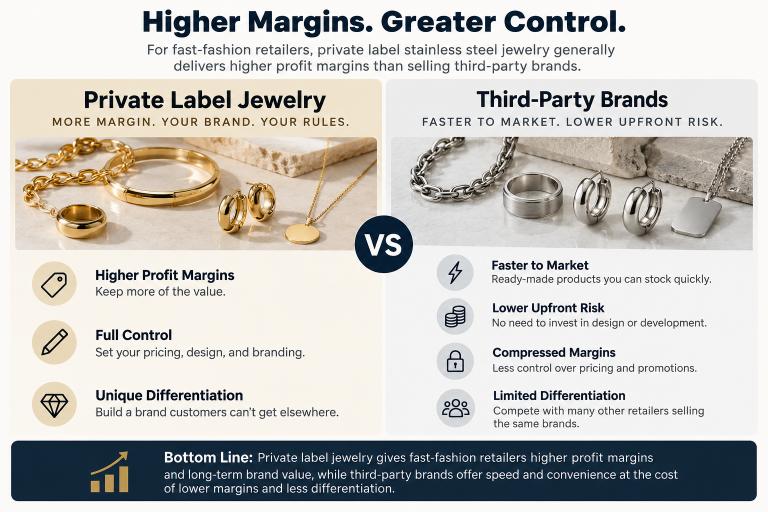
Both models have a place in the market. But most retailers I’ve talked to underestimate how much the sourcing model shapes their long-term profitability. Let’s break down each angle so you can make a smarter decision for your business.
Is Private Label Still Profitable?
Everyone seems to be launching a private label jewelry brand these days. So you might be wondering — is there still room to make real money with this model, or has it gotten too crowded?
Yes, private label is still profitable in 2024 and beyond. Retailers who manufacture stainless steel jewelry under their own brand name consistently achieve gross margins of 50–70%, compared to 20–35% when reselling third-party brands. The key is choosing the right manufacturing partner and keeping MOQ low during the testing phase.
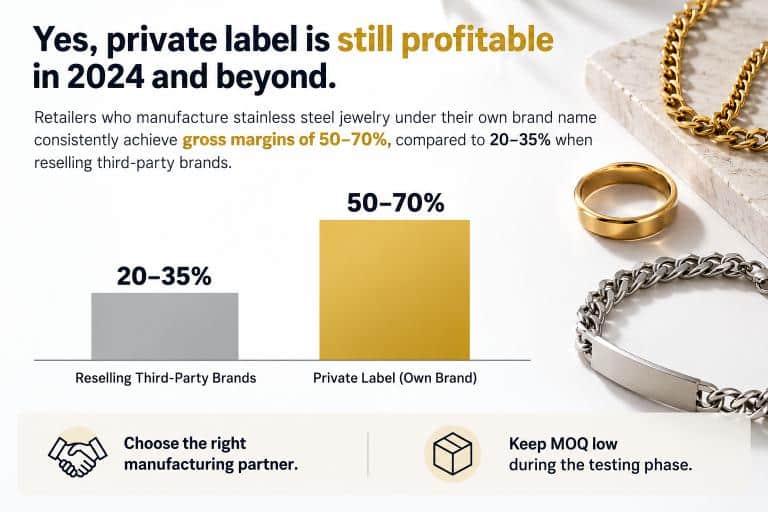
The private label model works because you own the brand equity. Every sale builds your brand, not someone else’s. And with stainless steel jewelry, the manufacturing cost is relatively low while the perceived value remains high — especially with PVD gold plating and premium packaging.
Why Stainless Steel Makes Private Label Even More Profitable
Stainless steel is one of the best materials for private label jewelry. Here’s why:
- It’s durable and waterproof, which reduces return rates
- PVD plating holds color longer than brass or zinc alloy
- It’s hypoallergenic, which reduces allergy complaints
- Manufacturing cost is competitive, especially with Chinese OEM suppliers
Margin Comparison: Private Label vs. Third-Party Resale
| Factor | Private Label | Third-Party Brand |
|---|---|---|
| Gross Margin | 50–70% | 20–35% |
| Brand Equity | Builds your brand | Builds supplier’s brand |
| Pricing Control | Full control | Limited by MAP policies |
| Reorder Flexibility | Alta | Depends on supplier stock |
| Differentiation | Alta | Bajo |
I’ve spoken with buyers from DTC jewelry brands in the US and UK who switched from reselling to private label after their first year. Almost all of them said the same thing — the margin difference alone justified the switch. One buyer told me her cost per unit dropped by 40% after moving to a direct OEM supplier, and she was able to price her pieces at a premium because the brand felt more exclusive.
If you’re considering launching your own private label stainless steel line, working with a manufacturer that offers low MOQ and fast sampling makes the entry point much more manageable. At Zehore Jewelry, we support brands at exactly this stage — with 7-day sampling and no pressure on minimum quantities for first orders.
What Are the Downsides of Private Label Brands?
Private label sounds like the obvious winner. But if it were that simple, every retailer would already be doing it. There are real challenges you need to know before you commit.
The main downsides of private label brands include higher upfront investment, longer lead times for custom production, design and IP risks, and the need for more active supplier management. Retailers who aren’t prepared for these challenges often face delays, quality issues, or inventory problems that hurt their margins.
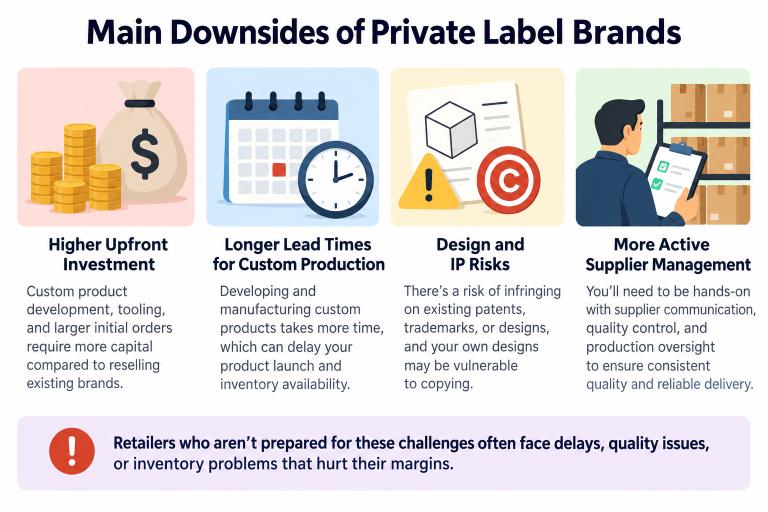
Private label requires more work. You’re not just buying a product — you’re building a supply chain. And that comes with its own set of risks.
The Real Challenges of Running a Private Label Jewelry Line
1. Design and IP Exposure
When you develop original designs with a manufacturer, there’s always a risk of design leakage. This is a real concern, especially when working with factories that serve many clients. The best way to protect yourself is to sign an NDA before sharing any design files, and to work with manufacturers who have a clear process for IP protection.
2. Sampling and Lead Time
Custom production takes time. A typical jewelry sampling cycle is 7–14 days. Bulk production usually runs 15–30 days after sample approval. If you’re running a fast-fashion business, this timeline can feel slow. You need to plan your collection calendar in advance.
3. Quality Consistency Across Batches
One of the most common complaints I hear from buyers is that bulk orders don’t match the sample. Color differences, plating inconsistencies, and stone setting issues are real problems. This is why choosing a manufacturer with strong quality control processes matters more than just choosing the cheapest price.
4. Inventory Risk
When you own the brand, you own the inventory. If a style doesn’t sell, you can’t return it to a supplier. This is why testing with low MOQ before committing to large orders is so important.
Downside Summary Table
| Challenge | Impact | How to Mitigate |
|---|---|---|
| Design leakage | Loses competitive edge | Sign NDA, work with trusted factories |
| Long lead times | Misses trend windows | Plan 6–8 weeks ahead |
| Batch inconsistency | Returns, brand damage | Request pre-shipment inspection |
| Inventory risk | Cash flow pressure | Start with low MOQ test orders |
| Supplier management | Time-intensive | Build a long-term supplier relationship |
I’ve seen brands get burned by all four of these issues. The good news is that they’re all manageable. The key is to treat your manufacturer as a long-term partner, not just a vendor. When you build that relationship, communication gets faster, quality gets more consistent, and your lead times shrink over time.
What Is the Opposite of a Private Label Brand?
Before we go further, it’s worth being clear on the terminology. A lot of retailers use "private label" and "white label" interchangeably, but they’re not the same thing. And neither is the same as selling a third-party national brand.
The opposite of a private label brand is a national or third-party brand — products manufactured and sold under a brand name owned by the original producer. Retailers who sell these products act as resellers or distributors. They have no ownership of the brand, no control over pricing strategy, and no ability to differentiate the product.
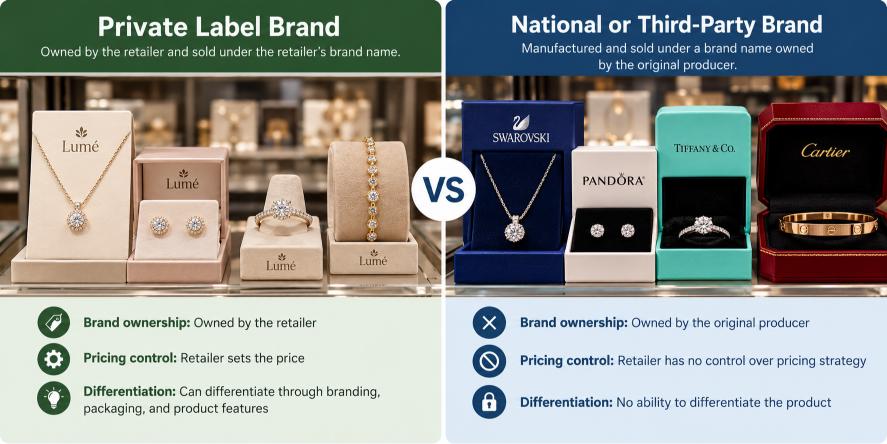
Understanding where your product sits in this spectrum directly affects your pricing power and your long-term business value.
Three Models You Should Know
Private Label: You commission a manufacturer to produce jewelry under your brand name. You own the brand, the design (if custom), and the customer relationship. This is the model used by most DTC jewelry brands.
White Label: The manufacturer produces a standard product that multiple retailers can sell under their own brand names. You don’t own the design, but you brand the packaging. Margins are better than reselling, but differentiation is limited.
Third-Party / National Brand Resale: You purchase finished goods from a brand that already owns the product identity. You sell it as-is. You have no pricing power beyond what the brand allows.
Model Comparison for Fast-Fashion Jewelry Retailers
| Model | Brand Ownership | Margin Potential | Differentiation | Velocidad de comercialización |
|---|---|---|---|---|
| Private Label (Custom) | Full | High (50–70%) | Alta | Slower (7–30 days) |
| White Label | Partial | Medium (35–50%) | Bajo | Fast |
| Third-Party Brand Resale | None | Low (20–35%) | None | Very Fast |
For fast-fashion retailers, white label is often a good middle ground when you’re just starting out. You get to put your brand on a product without the complexity of full custom design. But as your brand grows, moving to full private label custom manufacturing is where the real margin and brand equity live.
If you’re currently at the white label stage and want to explore custom OEM production, feel free to reach out. We work with brands at every stage of this transition.
How Does a National Retailer Benefit from Selling Private-Label Brands?
You might think private label is only for small DTC brands. But national retailers — department stores, fast-fashion chains, and large e-commerce platforms — have been using private label for decades. And there’s a reason they keep doing it.
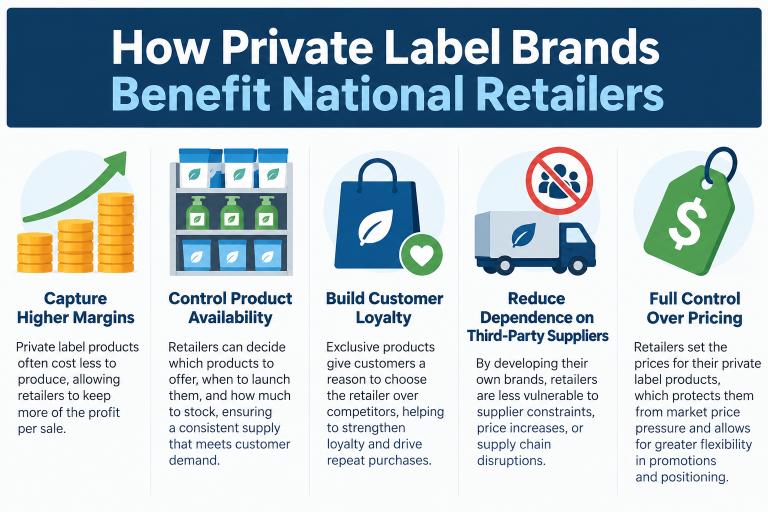
National retailers benefit from private label brands by capturing higher margins, controlling product availability, building customer loyalty around exclusive products, and reducing dependence on third-party suppliers. Private label also gives retailers full control over pricing, which protects them from market price pressure.
Large retailers like H&M, Zara, and ASOS have built entire jewelry lines under their own brand names. These products often sit at similar price points to branded alternatives, but the retailer captures the full margin instead of sharing it with a brand owner.
Why National Retailers Love Private Label Jewelry
Margin Capture
When a retailer sells a third-party brand, they typically make 20–35% gross margin. When they sell their own private label product, they can make 55–70%. On a $1M jewelry revenue line, that difference can be worth hundreds of thousands of dollars per year.
Exclusivity and Differentiation
Private label products can’t be found anywhere else. This gives the retailer a competitive edge. Customers who want that specific piece have to come back to that retailer. This drives repeat purchases and brand loyalty.
Supply Chain Control
With private label, the retailer controls the product spec, the quality standard, and the production timeline. They’re not dependent on a brand’s availability or pricing decisions. This is especially valuable during high-demand periods like holiday seasons.
Pricing Power
Private label products are not subject to MAP (Minimum Advertised Price) policies set by brand owners. The retailer can price freely — higher to protect margin, or lower to drive volume.
Benefit Breakdown for National Retailers
| Benefit | Private Label | Third-Party Brand |
|---|---|---|
| Gross Margin | 55–70% | 20–35% |
| Product Exclusivity | Sí | No |
| Pricing Freedom | Full | Restricted by MAP |
| Supply Chain Control | Full | Limited |
| Customer Loyalty Driver | Alta | Medio |
I’ve worked with sourcing managers at mid-size fashion retailers who were skeptical about private label at first. Their concern was always the same — "we don’t have time to manage custom production." But once they found a reliable OEM partner with fast sampling and clear communication, they never went back to reselling third-party brands.
The operational overhead is real. But the margin and brand control you gain more than compensate for it.
FAQs
Q1: What is the minimum order quantity for private label stainless steel jewelry?
A1: MOQ varies by manufacturer. At Zehore Jewelry, we support low MOQ orders to help brands test new styles before committing to bulk production. This makes private label accessible even for growing brands with limited budgets.
Q2: How long does it take to get samples for a private label stainless steel jewelry order?
A2: Most reliable OEM manufacturers can deliver samples within 7–14 days after design confirmation. At Zehore Jewelry, we offer 7-day sampling with 24-hour 3D design support to speed up the development cycle.
Q3: Is stainless steel jewelry a good material for private label fashion brands?
A3: Yes. Stainless steel is durable, waterproof, hypoallergenic, and cost-effective. It’s one of the best materials for private label jewelry because it delivers a premium look at a competitive manufacturing cost, with strong color retention through PVD plating.
Q4: How do I protect my jewelry designs when working with an OEM manufacturer?
A4: Always sign an NDA before sharing design files. Work with manufacturers who have a documented IP protection process and a track record of working with international brands. Ask directly about their design confidentiality policies before placing any order.
Q5: Can I switch from reselling third-party jewelry brands to private label without disrupting my business?
A5: Yes. Most retailers start by running both models in parallel. You test private label styles alongside your existing third-party inventory. As your private label line proves out, you gradually shift more of your catalog to your own brand.
Conclusión
Private label wins on margin and brand control. Third-party brands offer speed but limit your growth. For stainless steel jewelry, private label is the smarter long-term play.


 English
 Spanish
 French
 German