.png.webp)
China vs. Southeast Asia for Stainless Steel Jewelry Manufacturing: Supply Chain Pros and Cons for Buyers
Choosing the wrong manufacturing region can cost you months of delays, failed samples, and wasted budget. If you’re sourcing stainless steel jewelry, this decision matters more than most buyers realize.
China and Southeast Asia both offer stainless steel jewelry manufacturing, but they are not equal. China leads in infrastructure, pricing, and customization depth. Southeast Asia offers lower labor costs but often lacks the supply chain maturity needed for consistent quality at scale.
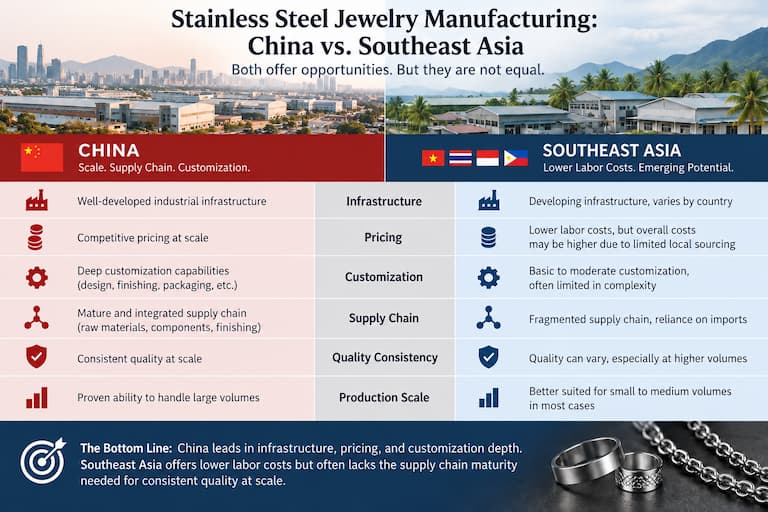
There’s a lot more to this comparison than a simple cost table. I’ve broken down the key questions buyers ask most, so you can make a sourcing decision based on real supply chain factors — not just price per unit.
Is Chinese Steel Better Than US Steel?
You’ve probably seen this debate online. Some buyers worry about material quality before they even pick a supplier. And if you’re building a jewelry brand that promises durability, this question isn’t just academic.
Chinese stainless steel used in jewelry manufacturing — primarily 304 and 316L grades — meets international standards for corrosion resistance and hypoallergenic performance. It is not inferior to US steel for jewelry applications. The grade and processing method matter far more than the country of origin.

Let me be direct about something I see confuse buyers all the time. "Chinese steel" is not one thing. There are dozens of steel mills in China producing material at very different quality levels. The same is true in the US, Europe, and anywhere else. What actually determines the quality of your finished jewelry is the steel grade your manufacturer specifies, and how they process it.
What Steel Grades Actually Matter for Jewelry?
| Steel Grade | Nickel Content | Resistencia a la corrosión | Common Use |
|---|---|---|---|
| 304 Stainless Steel | ~8% | Good | Fashion jewelry, everyday wear |
| Acero inoxidable 316L | ~10-14% | Excelente | Waterproof jewelry, sensitive skin |
| 201 Stainless Steel | ~3.5-5% | Lower | Budget accessories |
Most reputable Chinese jewelry manufacturers use 316L for premium lines and 304 for standard collections. If a supplier is quoting you very low prices on "stainless steel jewelry" without specifying the grade, that’s a red flag — they may be using 201, which tarnishes faster and has higher nickel migration risk.
When I evaluate a new supplier, I always ask for the material spec sheet upfront. Any serious manufacturer will provide this without hesitation. The ones who deflect that question are the ones to avoid.
For buyers in the US, EU, or Australia, the more relevant concern isn’t "Chinese steel vs. US steel." It’s whether your supplier can provide REACH/RoHS compliance documentation and SGS test reports for nickel release. That’s what protects your brand and your customers.
Who Is the Best Jewelry Supplier in China1?
This is one of the most searched questions in the jewelry sourcing space, and I understand why. Finding a reliable supplier feels like looking for a needle in a haystack when you’re starting out.
There is no single "best" jewelry supplier in China for every buyer. The right supplier depends on your product category, order volume, customization needs, and compliance requirements. The best suppliers combine OEM/ODM capability, low MOQ flexibility, fast sampling, and verifiable quality documentation.

I’ll give you a more useful framework than a ranked list, because ranked lists of "best suppliers" are usually paid placements or outdated.
How to Evaluate a Chinese Jewelry Supplier
| Evaluation Criteria | What to Look For | Red Flags |
|---|---|---|
| Product Specialization | Focuses on your specific material (e.g., stainless steel) | Makes everything for everyone |
| MOQ Policy | Flexible, supports sampling | Rigid 1000+ MOQ from day one |
| Sampling Speed | 7-14 days for first sample | Weeks of silence after inquiry |
| Customization Depth | 3D design support, OEM/ODM experience | Only sells from existing catalog |
| Compliance Docs | REACH, RoHS, SGS, BSCI available | "We can get that later" |
| Comunicación | Fast, clear English responses | Slow replies, vague answers |
The manufacturing hubs you should focus on are Guangdong province (especially Dongguan, Shenzhen, and Guangzhou), Zhejiang (Yiwu), and parts of Fujian. These regions have the deepest supply chains for stainless steel and brass jewelry.
Dongguan in particular has a strong concentration of stainless steel jewelry factories with export experience. Many of them have been supplying US and EU brands for over a decade and understand compliance requirements well.
If you’re building a private label brand and need consistent quality with low MOQ, I’d recommend starting with a manufacturer that offers 3D design support and in-house plating. That combination reduces the number of vendors you’re coordinating with, which directly reduces your risk of batch inconsistency.
At Zehore Jewelry, we work with DTC brands and importers who need exactly this kind of setup — low MOQ, 7-day sampling, and full OEM/ODM support. If that matches your sourcing needs, feel free to reach out.
What Are the Current Supply Chain Issues Associated With China?
This is the question every sourcing manager is asking right now. And it’s a fair one. Ignoring supply chain risk is how brands get caught with empty inventory during peak season.
Current supply chain challenges with China include US-China tariff pressures, port congestion risks, longer lead times during peak periods, and geopolitical uncertainty. These are real issues, but they affect all manufacturing regions to varying degrees. The key is building contingency into your sourcing strategy.

I want to give you a realistic picture here — not a fear-based one and not a dismissive one.
China Supply Chain: Real Risks vs. Overstated Risks
| Issue | Reality Level | How to Manage It |
|---|---|---|
| US Tariffs (Section 301) | Real and ongoing | Factor into landed cost calculations |
| Factory Shutdowns (CNY, Golden Week) | Predictable | Plan orders 6-8 weeks ahead of holidays |
| Port Congestion | Occasional, not constant | Use air freight for urgent orders |
| Quality Inconsistency | Supplier-specific, not country-wide | Vet suppliers thoroughly, use pre-shipment inspection |
| IP / Design Leakage | Real risk with wrong suppliers | Use NDA, work with audited suppliers |
| Geopolitical Uncertainty | Ongoing background risk | Diversify if volume justifies it |
Southeast Asia — particularly Vietnam, Thailand, and Indonesia — has grown as an alternative for jewelry manufacturing. Some buyers are moving part of their sourcing there to reduce tariff exposure or diversify risk. That’s a reasonable strategy at scale.
But here’s what I see happen with smaller brands. They move to Southeast Asia expecting to find the same infrastructure China has built over 30 years. They find longer lead times, less developed supply chains for specialized materials, and fewer factories with OEM/ODM experience. They often come back to China for the core of their production.
The honest answer is this: China’s supply chain challenges are real but manageable with good planning. Southeast Asia is a viable secondary option, not a full replacement — at least not yet for most stainless steel jewelry buyers.
One practical move I recommend: work with a Chinese manufacturer who has experience exporting to your specific market. They’ll know the documentation requirements, the shipping routes, and how to handle customs compliance. That experience is worth more than a slightly lower unit price from a less experienced factory.
Is Jewelry in China Cheaper?
Price is always part of the conversation. But the way most buyers frame this question leads them to bad decisions. It’s not just about the unit price.
Jewelry manufactured in China is generally cheaper than equivalent products made in Southeast Asia, Europe, or North America when comparing unit cost. However, total landed cost — including tariffs, shipping, inspection, and sampling — must be calculated to make a fair comparison.

Let me break down the full cost picture, because "cheaper" means different things depending on where you’re shipping to and what you’re buying.
Cost Comparison: China vs. Southeast Asia for Stainless Steel Jewelry
| Cost Factor | China | Southeast Asia (e.g., Vietnam, Thailand) |
|---|---|---|
| Unit Manufacturing Cost | Lower (mature supply chain, scale) | Slightly higher in most cases |
| US Tariff Exposure | Higher (Section 301 applies) | Lower or none for some categories |
| Shipping Cost to US/EU | Moderate (established freight lanes) | Similar to slightly higher |
| Sampling Cost & Speed | Low cost, fast (7-14 days typical) | Often higher cost, slower |
| MOQ Flexibility | High (many factories offer low MOQ) | Lower flexibility in most cases |
| Customization Cost | Lower (more competition, more options) | Higher for complex OEM work |
| Compliance Documentation | Widely available (REACH, SGS, BSCI) | Less standardized, harder to obtain |
For US-based buyers specifically, the tariff situation changes the math. Section 301 tariffs on Chinese goods can add 7.5% to 25% depending on the product classification. That’s a real cost that needs to go into your landed cost calculation.
For EU, UK, Australian, and Canadian buyers, the tariff situation is different. Chinese jewelry imports face standard duties that are often lower than US rates, which makes China’s cost advantage more straightforward.
Here’s what I tell buyers who are purely focused on unit price: a lower unit price from a supplier who delivers inconsistent quality, slow samples, and no compliance documentation is not actually cheaper. You pay for it in rejected inventory, customer returns, and brand damage.
The real cost advantage of working with an experienced Chinese manufacturer is the combination of competitive unit pricing plus infrastructure — fast sampling, OEM capability, compliance support, and reliable lead times. That combination is hard to find at the same price point anywhere else right now.
If you’re sourcing stainless steel jewelry and want a realistic quote that includes sampling, packaging, and lead time — not just a per-unit number — you can contact our team at Zehore Jewelry for a full breakdown.
FAQs
Q1: Can Chinese jewelry manufacturers provide REACH and RoHS compliance documentation?
A1: Yes. Reputable Chinese jewelry manufacturers can provide SGS, REACH, RoHS, and BSCI documentation upon request. Always confirm this before placing a bulk order. Not every factory offers this, so ask upfront during supplier vetting.
Q2: What is the typical MOQ for stainless steel jewelry from Chinese manufacturers?
A2: MOQ varies by supplier. Many experienced OEM factories offer 50-100 pieces per design for sampling and 200-500 pieces for bulk production. Low MOQ is a key advantage of working with mid-size Chinese manufacturers compared to larger factories.
Q3: How long does sampling take from a Chinese jewelry manufacturer?
A3: Most established manufacturers offer 7-14 day sampling for standard designs. Complex custom designs with 3D modeling may take slightly longer. Always confirm the sampling timeline and cost before starting a project.
Q4: Is Southeast Asia a good alternative to China for stainless steel jewelry?
A4: Southeast Asia is a viable option for reducing tariff exposure, particularly for US buyers. However, the supply chain for stainless steel jewelry is less mature than China’s. Expect higher sampling costs, less OEM flexibility, and fewer compliance-ready factories.
Q5: How do I protect my jewelry designs when working with a Chinese manufacturer?
A5: Use a signed NDA before sharing designs. Work with audited suppliers who have a track record with international brands. Ask about their IP protection policy. Reputable manufacturers understand this concern and will support it.
Conclusión
China leads on cost, infrastructure, and customization depth. Southeast Asia offers tariff advantages but can’t match China’s supply chain maturity for stainless steel jewelry — not yet.
-
"Key Factors to Consider When Selecting a Jewelry Supplier", https://www.entrepreneurshiplife.com/key-factors-to-consider-when-selecting-a-jewelry-supplier/. Evaluating the optimal jewelry supplier in China depends on factors like specialization, MOQ policies, and compliance capabilities, making a singular best impossible to define universally. Evidence role: evaluation criteria; source type: industry analysis. Supports: There is no single ‘best’ jewelry supplier in China for every buyer.. Scope note: Applies to diverse buyer needs and supplier capabilities rather than a fixed market ranking. ↩


 English
  Spanish
  French
  German